

My November 2026 ‘Deep Slate
LAST UPDATED: 2PM, 10/31/2026
The latest edition of my San Francisco & California Voter Guide.
👋🏽 Click to learn who I am and why you might care about my endorsements.
My name’s ‘Deep (Amandeep Jawa). I’ve been writing this lefty, do-gooder, environmentalist voter guide for my friends since 1995. By day I’m a software engineer; on my own time I’m a long-time local environmental activist. I’m not paid a dime for this. I’ve lived in San Francisco since 1992, in the Mission with my wife, daughter, and dog.
My priorities are environmentalism, social justice, and good-government reform. I try to be upfront about my biases and reasoning — read more on my About page and judge for yourself. More about the Deep Slate →
Hi everyone!
It’s a big election for the country, the state, and locally. I’m hopeful about the midterms, but still… 🤞🏽
Everyone wants to talk about the Billionaire Tax, and I get it: it’s great and terrible and confusing and obvious all at once. It was easily the toughest call on this ballot.
The races nearest and dearest to my 💙, though, are all San Francisco ones:
- It’s hard to overstate the importance of the Regional Transit Measure and Prop H.
- We have a BIG congressional contest that’s unbelievably INANE. There’s a GREAT candidate and… well, I’m sure she has her good qualities, but they aren’t apparent in her work.
- The never-ending Sunset Dunes fight gave me one of my all-time favorite Deep Slate write-ups (💔 is hard), but my wife says Prop 38 is better.
Also, this is the biggest ’Deep Slate ever, more than 1.5x the size of my previous longest 😳. And I think it’s the best researched ever, and it took the longest to write. The reason: AI for research is amazing (but fear not: 100% of the writing and thinking is me).
That said, I worry it’s too much of a good thing 🤔: too long for you to read, and too much work for me to keep doing. I’ll discuss more in the post’s comments, but it would mean a lot to hear what you think: Is all this a better ’DeepSlate?
Thank you for caring by voting,
‘deep
And if you like this, please forward it to anyone who might care!
(Thank-yous, #votingstickerselfie and the email list are at the bottom now.)
IF YOU ONLY READ ONE THING:
THE LIST:
The more CAPITALS, the more strongly I feel about it.
Click a title to jump to the details. Printable plain-text version.
FEDERAL:
STATE:
- Governor Xavier Becerra
- Lieutenant Governor ugh no 👎🏽
- Secretary of State Shirley Weber
- Controller malia cohen
- Treasurer Eleni Kounalakis
- Attorney General Rob Bonta
- Insurance Commissioner Ben Allen
- Superintendent of Public Instruction Richard Barrera
- Board of Equalization, D2 John Pimentel
- State Assembly, D17 matt haney
- State Assembly, D19 Catherine Stefani
- Prop 1: Housing Affordability Bond YES
- Prop 2: Rainy Day Fund YES
- Prop 3: Extend High-Earner Income Tax YES
- Prop 4: Campaign Finance Reform YES
- Prop 5: Recall Process Reform YES
- Prop 37: Loans for Middle-Income Homebuyers Yes
- Prop 38: Sweetheart Deal for ONE Immunology Research Lab NO-NO-NO
- Prop 39: TRUMPIST LIES ABOUT VOTER ID NO-NO-NO
- Prop 40: Billionaire Tax No
- Prop 41: (a.k.a. Prop 40 Poison Pill #1) Audits of Special Taxes / Spending Limit NO-NO-NO
- Prop 42: (a.k.a. Prop 40 Poison Pill #2) Prevent Taxing Rich People NO-NO-NO
- Prop 43: Local Tax Vote Threshold NO
- Prop 44: Community Health Clinic Shakedown NO-NO-NO
- Prop 45: CEQA Changes NO-NO-NO
JUDICIAL:
SAN FRANCISCO:
- Assessor-Recorder Joaquin Torres
- Public Defender Mano Raju
- Board of Supervisors, D2 Stephen Sherrill
- Board of Supervisors, D4 Ugh
- Board of Supervisors, D6 Matt Dorsey
- Board of Supervisors, D8 Gary McCoy
- Board of Supervisors, D10 Theo Ellington
- Board of Education (3 seats) Kim, Tung, Fisher
- Community College Board (3 seats + 1 Partial Term) Ball, Lace, Tam, Ferguson
- BART Board, D8 SARA BARZ
- Prop A: Reasonable Commission Streamlining YES
- Prop B: Prep for a Public Bank YES
- Prop C: Upgrade the Housing Trust Fund for More Affordable Housing YES
- Prop D: Less Ballot Measures Please YES
- Prop E: City Admin Streamlining YES
- Prop F: Executive Branch Management Yes
- Prop G: KILL SUNSET DUNES PARK NO-NO-NO
- Prop H: STRONGER MUNI FOR ALL YES-YES-YES
- Prop I: Lock Up Transfer Taxes for Affordable Housing No
- Prop J: Close Transfer Tax Loophole on Foreclosures Yes
- Prop RTM: SAVE BAY AREA TRANSIT YES-YES-YES
THE DETAILS:
FEDERAL:
US CONGRESS, D11
SCOTT WIENER
Bottom line: Move our most accomplished and effective legislator (who works on GREAT stuff) to the U.S. Congress? YES.
There is a laundry list of big state/national issues that are important to me, and I expect you probably have a list too. If you do a little digging I’ll bet you’ll find Scott Wiener’s been working on at least part of it! Here are some of mine, and he’s not only worked on them, he’s led them:
- Climate Change:
Scott’s been a leader, authoring numerous important bills, including SB 253 – the country’s first state law requiring large companies to report their greenhouse gas emissions, and a host of others like battery storage rebates, solar permitting improvements, and working to improve CA’s ability to sue fossil fuel companies. - Housing:
Much of the “push” in California’s renewed “push” for more housing comes from Scott: He’s a big part of the reason the state of California is pushing cities to actually build housing, and the mechanism he’s focused on, the state’s “Housing Element,” does so with an eye to past racial discrimination. (More on this below) - Transportation:
Scott has gone from being the Muni-riding Supervisor who championed Muni, to the Bay Area legislator fighting the hardest to protect and improve Bay Area transit. The very reason the Regional Transit Measure and Prop H exist to try and save transit is because of Scott’s work. - Fighting the Trump Administration:
Scott’s been leading the charge against ICE with his NO Kings act, allowing people to sue ICE agents for violations of their constitutional rights. Also the “No Secret Police Act”, the first state ban on masked federal agents. KQED points out that people started suing ICE under No Kings within hours of Newsom signing it.
These are just the highlights for me because Scott really has done it all – he takes on big issues, creates meaningful legislation and he either gets it passed, or keeps at it until it does. It’s really remarkable actually. Don’t take my word for it, just Google around & you’ll find articles like this (a GREAT read):
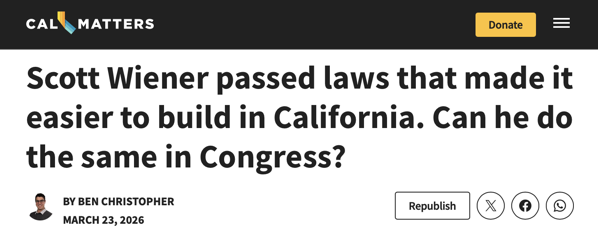
Or this quote from
the SF Examiner, on the 10 bills he authored THIS session:
If enacted, the bills would join more than 100 other adopted laws — spanning the fields of housing, health care, transit, LGBTQ rights and more — that Wiener has authored since 2016, when he was first elected to represent San Francisco and parts of northern San Mateo County in the California State Senate.
Scott is the kind of person we need in Washington: he has a chance to not only fill Nancy Pelosi’s big shoes, but to surpass her. Not to knock Pelosi, but I believe he cares about more of the stuff that I care about than she did. Regardless, he’s a fantastic candidate for this job, and we’re lucky to have the chance to send California’s “Best Senator” (according to Sacto insiders, not me), to D.C.
Ok, I guess I do have to mention Connie Chan, his competition.
Let’s see: she was against closing JFK to cars, so that’s a big NO. She was against Sunset Dunes Park and keeps trying to kill it, so another big NO. She’s fought every single major effort to allow the kind of dense urban infill housing that could make a difference in our housing crisis. It’s no surprise that “City data shows that Chan’s District 1 has authorized the [construction of the] fewest homes of any of the 11 supervisor districts since she took office in January 2021.”
Even if I agreed with Chan on things, which I often don’t, I’d ask her supporters: what she has done? What has she championed?
After extensive research, I’ve found…🦗🦗🦗🦗. Oh, wait, she championed!… Oh, whoops I misread, she was AGAINST the Geary express bus lane; one of Muni’s best recent successes. (Another big NO.)
This begs the question, why is this a race at all?!
I see two possible reasons:
- Scott is polarizing and has pissed off a lot of people.
- Nancy wants to keep the seat warm for her daughter and Connie fits this plan better.
Let’s start with the first one: He’s polarizing. I think this is the flip side of being effective and taking on difficult issues, especially the biggest difficult issue of housing. California needs a TON of housing and historically hasn’t built much. Scott has hung his hat on housing and has started making a real dent: for the first time in my 35+ years in California, the state seems to be honestly trying to grapple with this. Scott is one of the biggest reasons why. As CalMatters put it:
Since Wiener joined the state Senate in 2017, California’s legislature has undergone a historic pivot on housing. Majorities now embrace the notion, at least rhetorically, that the state has an active role to play in promoting the construction of more homes, even if that means bigfooting local governments and neighborhood groups. More so than any other legislator, Wiener has been the hinge of that pivot.
The irony is that some progressives have attacked Scott for “building all housing” rather than being focused on “building just affordable housing.” This analysis is easy and obvious, and like many things that come from Connie Chan, and similar folks (I’m looking at you League of Pissed Off Voters) – just too simplistic.
The problem is that affordable housing is notoriously hard to build AND generally much more expensive to build than market rate housing*. This makes attacking a given project “for not having enough affordable housing” excellent cover for a whole lot of “DON’T BUILD MORE HOUSING NEAR ME, BUILD IT NEAR POOR PEOPLE” voices trying to “protect” their richer and historically whiter, west-side and north-side enclaves (for a great writeup of this, I highly recommend SPUR’s “Why (and Where) San Francisco Needs to Allow More Homes: A Housing Element Primer”.) Add in the fact that the line “this project needs affordable housing” is a good sound bite to rally progressives who really do want much more housing all over the place, but don’t understand the more complex nuances and voilà “NIMBYism in Progressive Clothing” (a.k.a. Connie Chan).
Scott’s approach is to just BUILD ALL THE HOUSING, or as Capitol Weekly put it:
The most significant of those fights have been focused on his many efforts to address get [sic] more housing built in this state. More housing for students. More high density infill housing near transit. More affordable housing. More housing, period.
“Scott has become well known for so many different reasons, but I think his trademark is the fact that he has become the leading voice for more housing in California,” says Dan Dunmoyer, president and CEO of the California Building Industry Association.
“Scott recognizes that our housing crisis is actually a housing policy crisis,” Dunmoyer says. “We have all these policies we’ve put in place over the last 40 years that make it impossible to build anything, whether it’s urban infill or suburban or affordable or market rate. And so he has really called that out.”
It’s the only strategy that has made any difference and the real reason the last two mayors of San Francisco have started fighting to build housing, the Breed+Lurie “Family Zoning Plan.”
That brings us to the second reason this is a race at all, and frankly, the bigger of the two: Nancy Pelosi.
Pelosi, who is stepping down from an historic run in Washington, is backing Chan – hard. Why? It’s clearly not because she agrees on policy with Chan, the self-styled uber-leftist Dem. Pelosi is the poster child of the moderate Dem establishment that the left abhors; here’s an opinion piece from the Boston Globe:
It’s a curious choice, even if Wiener did annoy Pelosi by announcing he was running before she had made her retirement official. Chan is a progressive Democrat who has gained a reputation during her six years on the board as someone who opposes things — public transportation projects, housing development, and even Sunset Dunes, the city’s newest park — and not very successfully.
The opinion-piece above floats the only compelling conjecture I’ve heard, and while it is just a rumor, it’s still the best explanation: Nancy was really, really, really hoping her daughter Christine Pelosi would take the seat, and having a weak-link like Chan there will be an easier oust when Christine Pelosi is ready to take it on. I have not a single shred of evidence for this theory, and Christine herself calls this idea “cockamamie” and insists she’ll never run against Chan – make of that what you will. But, I’m wearing my skeptical pants 🧐 because it fits the facts better than anything else I’ve seen.
.ps I realize this post is chock full of “extra-reading” links, but if you want a great survey of the Family Zoning Plan, see this SPUR link.

US Congress, D15
Kevin Mullin
Bottom line: The only Democrat in the race. ✅
I honestly don’t know much about Congressman Mullin. He represents D15: basically much of the 101 corridor from South San Francisco to Palo Alto. As the only Democrat, I don’t need to.
STATE:
Governor
Xavier Becerra
Bottom line: The only Democrat in the race, but I’m not excited. 😶
I’m voting for Xavier Becerra, who I’m NOT excited about. Read my June post for details, but I’m pretty sure he’ll make us miss The Gavinator (who really does get climate change.) Becerra should win easily, if for no other reason than the bad porn-themed campaign ads from Republidiot Steve Hilton. (Just Google “Steve Hilton Cringe” – or head over to the NYT.)
Lieutenant Governor
ugh no 👎🏽
Bottom line: Ma will win, but UGH No.
This banger of a quote from the SF Chronicle says it all about our future Lieutenant Governor, Fiona Ma. She’ll win as the only Dem in the race:
In 2024, the state paid $350,000 to settle a lawsuit from a former treasurer’s office employee who alleged that Ma climbed into bed with her and exposed herself while sharing a hotel room. Ma told us in an endorsement interview that the lawsuit was a “frivolous” attempt to extract money and said she objected to state lawyers’ decision to settle. Yet as the judge in the case noted, Ma’s own evidence revealed that she called the employee “into her room while half-dressed on three separate occasions and climbed into bed with her on a fourth.”
😭😭😭🤦🏽♂️ (Ok I can’t laugh at sexual harassment, but “Ma’s own evidence”… just… wow.)
Secretary of State
Shirley Weber
Bottom line: A good incumbent by all reports! 👍🏽👍🏽
Every year she’s been up for election I say the same good things about Weber, mostly based on a glowing Chronicle endorsement editorial for her.
This year I’ll do the same, because the past decade has been one long civics lesson entitled, “‘No, Seriously, Democracy Is Fragile’ Starring Donald J. Trump”. A lot of the fight for our democracy has come down to Secretaries of State (of both parties even!) in state houses all over. So really, be thankful we have a strong, smart woman at the helm here, and re-elect Weber.
Also I’d be remiss, while we’re talking about Trumpist 5-parts-evil-2-parts-stupid attacks on voting, without imploring you to VOTE NO NO NO (Hell NO) ON Prop 39 – our very own Trumpist voter suppression bullshit.
Controller
malia cohen
Bottom line: The only Democrat in the race, but I’m not excited 😶
The Chronicle’s “well she might be improving?” endorsement is rich in details about why they are skeptical about her, and I have to agree. But hey, as usual around here, the Republican isn’t great. Sigh. Cohen.
Treasurer
Eleni Kounalakis
Bottom line: Kounalakis is the experienced and capable Democrat vs. the Republican with no experience and who has never held public office.
From what I’ve read about Kounalakis, she’s smart and capable. In the June primary I linked to The Chronicle’s endorsement, but now in November, The Chronicle is just re-running what they wrote in June. 🙃 I will point out that the Republican Challenger is UNIQUELY UNQUALIFIED to be the Treasurer of the world’s 4th largest economy. From the LA Times:
[Republican Candidate Jennifer] Hawks spent two decades working as an executive assistant at the Sacred Hearts School, a private Catholic school in the tony Silicon Valley town of Atherton, before her retirement in 2021. Before that, she worked in various human resources and office manager roles.
Attorney General
Rob Bonta
Bottom line: Smart, capable and experienced AG, vs. Trump Apologist Republican.
The LA Times says what you need to know:
Bonta is an establishment Democrat who has sued this Trump administration on behalf of the state more than 85 times and who vigorously defends California’s liberal and progressive policies — including on voting rights, transgender rights and immigrant rights.
Gates is a MAGA-style Republican who repeatedly has sided with the Trump administration on those hot-button issues and others and believes many of Bonta’s lawsuits against the administration are misguided.
Insurance Commissioner
Ben Allen
Bottom line: The most-experienced candidate with the most-thought-out plans.
I struggled with this one a lot more than I wanted to. In the end the conclusion was clear, it just wasn’t what I wanted. First, lemme lift what I said in June’s primary, verbatim:
According to Ballotpedia, here is the job of the Insurance Commissioner:
The commissioner oversees the California Department of Insurance, which regulates the state’s insurance industry. The Department of Insurance is charged with licensing insurance companies and reviewing their financial statements, establishing rate regulations, investigating consumer complaints, and punishing insurers with fines or penalties for regulatory noncompliance.
1. This historically sleepy technocratic office really should not be an elected position.
2. To call it “sleepy” is so “pre-climate change”A powerful combination of climate-change fueled disasters (Palisades anyone?) and insurance companies fleeing CA (maybe easier money elsewhere?) and perhaps ill-advised insurance reforms (?) has brought our State’s insurance market to a crisis point – in home owner insurance specifically. We need someone who gets it and who will start working on real solutions.
Of the candidates, Jane Kim is a friend and smart and capable so I could easily vote for her. But Ben Allen is endorsed by the California Environmental Voters and the Sierra Club, so I’m also strongly considering him. To be honest, like The Chronicle, I’m a bit skeptical of the pragmatism of Jane’s “get tough on insurers” approach. But for me she edges Allen out, because all other things being equal, I’ll give the smart, capable woman the benefit of the doubt.
Ok so “all other things being equal” was doing a lot of work in that June piece.
Back then, for the primary, only the top two vote-getters would make it to this election. Now we’re playing for keeps: either Jane Kim or Ben Allen will be California’s next Insurance Commissioner.
The thing is, Ben Allen has an extensive track record of digging into the details of insurance policy and climate change policy and crafting smart legislation. Literally everything I’ve read agrees on this point. Jane Kim has some great soundbites about remaking insurance in California and “holding big insurers accountable”… but her plans may or may not work. Even if a good thing, they seem unlikely to materialize: they’d have to be passed by the legislature when much of California is freaking out about insurance in the wake of the Palisades Fire.
Jane wants to create a single-payer universal disaster coverage system for California and wrestle big insurance companies into working within it. She has no experience creating such a system, because no one has one. She also has no experience navigating complex legislation through the California state legislature, which is very different from her time at the Board of Supervisors. Allen, on the other hand, has already worked with people directly affected by insurance problems, has worked with and against the big insurance companies, and has actually written a lot of key pieces of legislation that are helping Californians today.
This quote really struck me, when the SF Examiner asked, “I assume by “making promises you can’t keep,” you’re talking about the single-payer insurance plan that’s the centerpiece for her campaign.” Allen’s response was
Universal health coverage, Medicare for All, is something I’ve been very supportive of. I’ve actually voted for it publicly in the Legislature. But that actually exists as a real model in many countries.
What she’s proposing with regards to home and auto disaster insurance doesn’t exist anywhere. The closest thing is in New Zealand, where they cover up to $167,000 per unit, and [have a] much lower risk profile — only 5 million people in the whole country.
The other thing is, there’s no major difference in cost treating a cancer situation for a rich person or a poor person — but if you talk about their car or their home, all of a sudden there’s a huge inequity by having the state take over that liability. Saddling the state with the liability associated with all the insurance costs that might come after a major disaster is incredibly risky. That could bankrupt the state alone.
Ultimately, I don’t think Jane can accomplish her platform. And, even if she could, I’m not sure it would work. I’ll go with someone who’s done the work, understands the system, and knows where and what to push. Ben Allen. Yes.
UPDATE: Kimberly and I actually ran into Jane yesterday (maybe an hour after I finished writing this no less!), and she asked me if she could count on my vote. 🫣 After an uncomfortable pause, I told her what I thought – essentially what I’ve written here. We had a good chat, and she made a pretty compelling case that she knew what was what, how far to push things and how to try to make her ideas real. I hope she’s right – she’s certainly smart and capable. But in the end, while insurance is on fire, I don’t think we should try breaking and re-making the system. Ben Allen is the right call.
Superintendent of Public Instruction
Richard Barrera
Bottom line: Only Dem, and bonus! Not a crazy Trumper. ✅
Back in June I wrote a bit about what the Superintendent does. Evidently that has changed dramatically, because Newsom has reorganized how California’s schools work.
Read detail in The Chronicle here, but regardless, vote for Richard Barrera. He’s well respected and their quote says what you need to know: “Richard Barrera is an increasingly rare California progressive who brings all parties to the table, a skill that the new state superintendent of public instruction will need as the role of the office changes.”
Meanwhile the LA Times had this to say about the Republican opponent Sonja Shaw
Shaw broadly characterizes the public education system as failing because of liberal Democratic policies… she supports flag bans at schools — which were conceived to target gay pride flags — and book restrictions that target content deemed as sexually obscene.
She became politically activated by the pandemic’s prolonged school closures, COVID vaccine mandates and mask mandates — all of which she opposed.
Despite a consistent policy alignment with the Trump administration, Shaw, a longtime religious conservative and a small business owner, objects to any implication that she is falling into line behind Trump or that she is subservient to his policies.
🤮
Board of Equalization, D2
John Pimentel
Bottom line: I usually abstain, but Pimentel may get it!
The Chronicle argues convincingly that the Board of Equalization is largely duplicative of the Franchise Tax Board. Normally, I abstain in this race for that reason, but this year, The Chronicle reports that John Pimentel is open to dissolving it! Let’s go:
John Pimentel, a Democratic elected trustee of the San Mateo County Community College District and renewable energy executive, is no novice. He’s open to dissolving the board and has the political sophistication to make such a case to the Legislature and to voters.
State Assembly, D17
matt haney
Bottom line: Unopposed, has done some good stuff, but impropriety questions linger.
I discussed Matt back in my June post. He’s unopposed, but sigh… I’m pretty unhappy about the FPPC investigations and other clouds surrounding him.
State Assembly, D19
Catherine Stefani
Bottom line: Unopposed. ✅
Stefani is unopposed. See my June post — nothing new to add.
Prop 1: Housing Affordability Bond
YES
Bottom line: WE NEED ALL THE AFFORDABLE HOUSING so YES sell bonds to fund housing!
The simple “no brainer” case for this is exactly my “BOTTOM LINE” above: we need more affordable housing, to build it we need $$$, and the way we do that these days is general obligation bonds. This one is structured pretty well.
Basically, this allows the state to sell bonds to the tune of $10 billion to fund new affordable housing construction. In addition to being needed, passing this bond gives us access to more Low-Income Housing Tax Credit funds from the federal government.
SPUR’s write up is on the money, and covers the simple analysis.
However, after reading thoughtful write ups from my friend Alix Rosenthal and The Chronicle for Props 1, 2 and 3, I realized there was more to it. In the end, my vote hasn’t changed and I don’t think yours should either: we need affordable housing and this will help pay for it. Buuuuuuut, looking a little deeper, you can see the limits of this measure.
General obligation bonds for housing are essentially “credit card spending for necessities,” which is just a bad idea. We’ve been funding affordable housing construction this way for a while, but we need to find something better. As the bond’s author, well-regarded Assemblymember Buffy Wicks, told The Chronicle, California needs “sustained ongoing funding for affordable housing so that we’re not having to have this bond conversation every six years.”
And this gem from Alix, which literally made me laugh out loud, is in the same vein:
Once upon a time, California had redevelopment agencies, and those agencies had to set aside a share of their money for low-income housing, more than a billion dollars a year. Then in 2012, in the middle of a budget crisis, the Legislature killed redevelopment and never replaced the housing money. Since then, California has paid for affordable housing the way a college kid pays for spring break: sporadically, in lump sums, and on credit. Prop 1 is the latest trip to the ATM.
🤣🤣🤣
All this points to the need for actual stable funding, which leads into our next two “no brainers,” Props 2 and 3, which are about exactly that: tax policy. They are also easy YES votes, and also highlight deeper issues we should be addressing.
.ps Alix’s take on Props 1, 2 and 3 is my favorite bit of her excellent voter guide. I highly recommend reading her combo post for these three, I learned a lot.
Prop 2: Rainy Day Fund
YES
Bottom line: Grow our “Rainy Day Fund” to Mitigate California’s Boom-Bust Tax Policy.
Prop 3: Extend High-Earner Income Tax
YES
Bottom line: Extends existing high income taxes without which we’d be screwed.
Props 2 and 3 are two sides of the same problem: dealing with our tax policy and its volatility. Think of Prop 3 as the income, a paycheck, but sadly not a steady one. Prop 2 is kinda like the savings account that you keep because the paycheck has its ebbs and flows.
To be more specific, Prop 3 continues existing critical taxes on high-income earners, and Prop 2 makes our State’s “Rainy Day Fund” reserves bigger, so they can do a better job.
If you’re thinking “OK, easy! So we need both a paycheck and a savings account. I get it!”, you’re more-or-less correct and can vote YES on both! But the deeper story is more interesting and illuminates a more important reality.
Let’s start with the details of the “paycheck”. California established temporary high-income tax brackets in 2012 with Prop 30. They have been critical funding for California, particularly in education. These brackets were set to expire, but were extended by Prop 55 in 2016, and will expire in 2030. This measure would make these brackets permanent.
SPUR’s endorsement writeup summarizes it like this:
Prop. 3 would make permanent an existing high-earner tax that funds K–12/community college education, children’s healthcare, and debt paydown. This tax has generated more than $119 billion for education and healthcare, with no evidence that it has driven high earners out of state. It’s highly progressive, hitting only top earners while sustaining programs such as universal school meals that disproportionately benefit low-income students, and it would help backfill Medi-Cal funding just as federal cuts threaten healthcare access for millions of low-income Californians.
That’s enough to get you to the obvious truth: we really need this money. It’s an established tax so YES. But it also shows its weakness: what happens in the years when high-earners don’t earn? Our tax base is seriously volatile because about half of the state’s income taxes come from the top 1% of taxpayers. So if those high-income earners have a bad year, California has a bad year.
In good economic years Sacramento is flooded with cash, and in bad economic years we’re broke and scrambling. As The Chronicle points out in their endorsement, this boom-bust tax cycle precludes stable and sustainable funding for education, healthcare and all our other priorities. This is no way to run a state. We can, and should, do better.
Again, from The Chronicle:
Tying an oversized income tax to a priority as fundamental as public education is reckless. When the market tanks, as it is bound to every few years, California kids take the hardest hit.
To help address this, we have Prop 2, to make “the savings account” bigger and more useful.
In 2014, California established a “rainy day” fund to set aside money in boom years (rather than spending it), thus mitigating problems caused by tax volatility. The Rainy Day Fund is a good thing, just not enough of a good thing (from The Chronicle’s Prop 2 endorsement):
The 2014 measure capped the rainy-day fund at 10% of the general fund — only enough to cover about one-third of likely shortfalls during the next 50 years, the Legislative Analyst’s Office concluded after running thousands of simulations.
To make up the difference, California would have to cut core services during every economic downturn or raise taxes.
Neither are good options.
So Prop 2 has been placed on the ballot to improve the rainy day fund (from SPUR):
Increases the maximum balance of the state’s rainy day reserves from 10% to 20%, changes how deposits and withdrawals from the account are calculated and authorized, exempts deposits from state spending caps, and expands mandatory repayment of certain debts and unfunded liabilities.
The easy answer is Vote Yes on Prop 2, which will help!
Unfortunately, The Chronicle noted this large caveat in Prop 2: If the governor and legislature declare a state of emergency (and The Chronicle claims that “the state’s criteria for one are farcical”), none of the money needs to go to the rainy day fund – thus this budget discipline can be easily sidestepped, which is what has been happening: we’ve declared multiple fiscal emergencies in recent years, even while revenue was booming. 😐
All of this points to a more important reality beyond these two measures. Even if Props 2 and 3 pass, an unsteady paycheck and a savings account with no discipline aren’t a recipe for success. That means these Props are patches on a tax system that needs real reform. The Chronicle puts it like this:
Voters should support Prop 3 to sustain funding levels but keep pressure on their politicians to work toward a fairer and more sustainable tax system. Because the one we have can and will fail.
So we should absolutely pass Props 2 and 3, Vote YES, and then we should start demanding better.
.ps In my write up of Prop 40 below, I talk about how we need actual tax policy and Props 2 and 3 are at least actual policy – warts and all! These are the things we should be debating and improving, rather than making a one-off cash grab, like Prop 40.

Prop 4: Campaign Finance Reform
YES
Bottom line: Lift the statewide ban on public financing of campaigns: EASY YES. ✅
Most everyone hates how much money is involved in politics – polling shows that voters are appalled too. The best way to deal with it is public financing, but California has a ban that prevents all but a few cities from experimenting with public financing. This lifts that ban.
The legislature actually passed this as a law, but the courts ruled that since the ban was put on by the voters, lifting it had to be by a ballot measure. So here we are.
SPUR gets the details right, the enviros are for it, and this Cal Matters article lays it out. Oddly enough, The Chronicle is against this for dumb reasons and mischaracterizes parts of it. (Hey Chron, the FPPC is not prevented from oversight of all the implementations, it is just not required to do so.)
Prop 5: Recall Process Reform
YES
Bottom line: Cleans up the problematic recall process in California.
This is a fix to our odd, end-run-style recall process that allowed Republican Arnold Schwarzenegger to become Governor in an overwhelmingly Democratic California. Another recall was tried against Governor Newsom in 2021, with similar minority-topples-the-majority aspirations. This “it’s just so crazy, it just might work” approach can happen in California because of our archaic voting rules.
Basically, in our system, we put two questions on the ballot: “should there be a recall”, and, “pick the successor.” By doing so, a majority of folks can vote “yes” on the recall, everyone can pick different successors, and whichever successor gets the most votes wins – even if it’s not a majority. The graphic below breaks down an example: If there is a recall effort and 51% of the people vote for it, and there are five possible successors, whichever one gets the most votes – even with as low as 21% of the vote – wins. That’s just dumb, but it’s how it works.
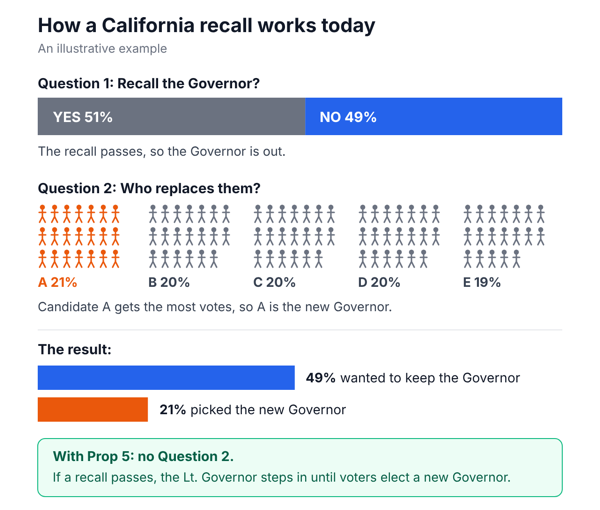
Look at this cool graphic I painstakingly created Claude made.
If Prop 5 passes, there will only be one question on the recall ballot: “Should there be a recall”. Then the Lt. Governor would step in until a new Governor could be elected through our normal process.
SPUR explains the rather tedious details , there is a good Cal Matters article, and The Chronicle is against it because they found a flaw. (They’re evidently all about the perfect being the enemy of the good.🤦🏽♂️) fixtherecall.com
Prop 37: Loans for Middle-Income Homebuyers
Yes
Bottom line: Sell bonds to (hopefully) help buyers of new homes get a down payment. 💰✅
This is a no-brainer… except that it might not work.
Buying a home in CA is prohibitively expensive for practically everyone. This measure aims to help a class of potential homeowners who can afford a mortgage, but not a down payment.
The State will sell bonds to fund down payment loans of up to 17% of the home value. So at best, assuming the down payment is the usual 20% of home value, the buyer would have to come up with 3% down payment and the state would loan them the other 17%. They would of course have to pay the state’s loan back, and that’s the biggest catch: the measure doesn’t set the interest rate – so the down payment loan you get will have some interest rate, hopefully better than market rate.
Additionally, the loan would have to be for new housing, rather than existing housing – an effort to goose new housing construction in our state. (I’m scared of funding suburban sprawl, but one problem at a time!)
Here are a few good questions as to whether this will work:
- Will investors participate? They buy the bonds that create the down payment loan pool.
- If investors buy the bonds, will it be at low interest rates, therefore creating low down payment loan interest rates?
- Will people actually apply to take on more debt when they are considering a home purchase?
- How many people will it help?
- Will it help the people who actually need it?
This article at CalMatters does a good job surveying these questions but none adds up to, “this is a bad idea”. It’s all a “it will probably help 🤷🏽♂️” kinda thing.
SPUR lays out the details well, as does The Chronicle; both are a yes. The Chronicle points out that this could fix a problem I didn’t know we have: laws attempting to protect new home buyers from shoddy construction have overshot and killed townhome/condo construction in CA.
Vote Yes. It’s a good experiment.
Prop 38: Sweetheart Deal for ONE Immunology Research Lab
NO-NO-NO
Bottom line: Put a measure on the ballot to get your pet science lab $4.2 billion in state bonds? HELL NO!
[Ed. Note: This is my second favorite write-up in this post! My wife says it’s her fave.]
This measure creates Big Science research bonds ($8.4 billion)! Hooray, immunology is one of the hotbeds of a lot of amazing breakthroughs right now – from cancer to immunodeficiency disorders, to long COVID!
…continues reading…
Wow, ok, that’s an oddly specific set of criteria for which labs get the funding from these bonds?
But still I loves me some Good Science – I’m sure there are lots of labs who qualify!
…continues reading…
Wait, just one lab qualifies? So, half of the $8.4 billion goes to just one lab? Really?
Well, I’m sure it’s a great lab! Like at Stanford, or UCSF, or UCLA or somesuch!
…continues reading…
Oh yeah – it’s at UCLA! they’re major leag… oh it says it’s at UCLA, but that’s mostly because it’s renting space at a research park of theirs?
…continues reading…
But still – I’m sure sending so much money to one great and accomplished lab … wait, not “great and established”?
California has many established and well-regarded research institutes — including some that have made significant advances in these fields.
But the California Institute for Immunology & Immunotherapy is not among them.
Instead, it’s a brand-new institute, and its founders include the same billionaires who paid to put Prop 38 on the ballot: Surgeon Gary Michelson, businessman Meyer Luskin and financier Michael Milken, who, in addition to his longtime financing of medical research, is also known as the “junk bond king.” He was pardoned by President Donald Trump in 2020 for his 1990 guilty plea to racketeering and securities fraud.
— The SF Chronicle’s “Endorsement: Prop 38 is one of the most noxious deposits on California’s political dung heap in years”
This is terrible.
…continues reading…
Oh, for F%^*k’s sake: as of September, this brand-new institute about to get $4.2 billion had three employees.
So that’s $4.2 billion in state bonds for one brand-new institute with three employees, founded by the billionaires who paid to put it on the ballot.
🤬🤬🤬
.ps Way back in 2004 I was a supporter of Prop 71, Big Science bonds for Stem Cell research. The Chronicle endorsement above links to an analysis piece they did on how those 2004 bonds panned out for California. I need to read it when I’m done typing this beast!
Prop 39: TRUMPIST LIES ABOUT VOTER ID
NO-NO-NO
Bottom line: Expensive, stupid, evil, and unnecessary. (But other than that, what’s not to like?!)
OMFG.
I. CAN’T. EVEN.
This measure, brought to us by a midwestern Trumpist billionaire $$$ and Sacramento’s most disliked legislator Republican Carl DeMaio, is easily the most evil and noxious idea on the ballot.
You’ve seen this movie many times now, from Trump since 2020 (especially the SAVE Act) and Republicans of his ilk: drum up a fabricated story that elections are insecure and at risk. Use this misinformation to push through legislation to actually erode our democracy by disenfranchising as many voters as possible – especially in communities that lean Democratic.
Luckily, The Chronicle and SPUR managed to do what I could not, and wrote thoughtful, meaningful takes on this abhorrent piece of legislation. If you need to understand this in greater detail, please do read them, but here are some highlights in no particular order:
- Expensive (from The Chronicle):
To vote in person, Californians would need to show a government-issued ID. Prop 39 mandates the state provide free “voter identification cards” — which do not currently exist — to those who request them. The nonpartisan Legislative Analyst’s Office estimated that creating these cards, in addition to other expenses resulting from Prop 39, could cost local and state governments hundreds of millions of dollars a year.
- Stupid (from SPUR):
Pros: SPUR could not identify any benefits to this measure.
(LOL)
- Evil (from SPUR):
Research consistently finds that voters of color, low-income individuals, elderly voters, students, people with disabilities, and those who recently changed their names are less likely to possess the specific government-issued IDs required under strict voter ID laws and are more likely to face barriers to obtaining them.
Costs — including fees for birth certificates and other documents, transportation to government offices, and time away from work — can create additional burdens.
Researchers have documented racial disparities in ID possession and evidence that strict voter ID requirements can widen racial turnout gaps. Approximately 13% of Black Americans lack acceptable voter ID, compared with 5% of white Americans, making voter ID laws a significant equity issue.
- Unnecessary (from The Chronicle):
Prop 39 is “the best way to shut down the conspiracy theories that irresponsible politicians spread,” DeMaio said. Well, no.
The best way is for those irresponsible politicians, paramount among them DeMaio’s ally, President Donald Trump, to stop sowing unfounded disbelief.
Because by every available measure, California’s voting system is working.
Prop 40: Billionaire Tax
No
Bottom line: An ill-conceived cash grab masquerading as tax policy (as much as it’s trying to solve the right problem).
[Ed. note: Unsurprisingly, this is the one most peeps seem to want to talk about. After a lot of thinking, I ended up a “reluctant No”, see below. But I have several smart pro-40 friends that have said to me “on this one, turn off your 🧠 and send a message!” and I get it. I see the appeal and don’t totally disagree, but I think the downsides & risks are too high.]
This is a tough one. When I first heard of this I thought, “Maybe yes? It could be good, ’cause the rich keep getting richer and the poor keep getting poorer.” Or maybe you thought of Elon Musk and the idea of taxing him off the face of the planet… so dreamy… oh sorry. Got lost for a second. But seriously, wealth inequality is bad bad bad.
Your second thought may have been, “How would that work?” or, “Would they all leave Cali? What would happen if they did?”… so then you’d start reading, looking for more info. SPUR is a go-to of mine for thoughtful policy analysis!

Aaaannnnnd…. they couldn’t decide.
Gee. Thanks SPUR.
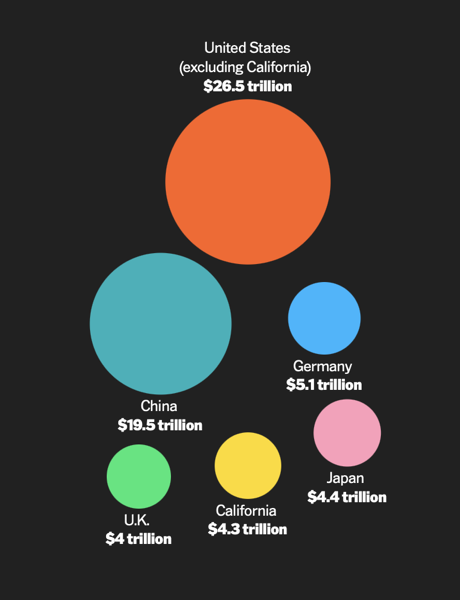
So then I started reading. The more I read, the more I started getting the sense that as much as we need to take on wealth inequality, this is not really an attempt to create a thoughtful tax policy; this is a one-off “let’s grab billionaire money and send it to healthcare, because Trump is killing Medi-Cal”. Healthcare does need the money after the “One Big Beautiful Bill” 🤮 shredded Medi-Cal to the tune of about $20 Billion/year!!!! So maybe this is still a good thing?
Then I read this pair of excellent pieces:
- NYT’s “How California’s Ultrarich Are Trying to Stop the World’s First Billionaire Tax”, a deep dive into the ideas behind the tax and how we got here, and a good discussion with the proponents and opponents. It’s a great read.
- Katie Porter’s OpEd in the SF Chronicle: Don’t be fooled by the California billionaire tax’s false progressive bravado. An Op-Ed from former Congresswoman Katie Porter (and now law professor at UC Irvine) who has impressed me time and time again, and is well known as a smart and incisive policymaker. She’s very focused on income inequality.
In the NYT article, Porter is quoted saying this is “ill-conceived” and will probably hurt the chances of a real and good wealth tax. In The Chronicle, she makes the full case as to why this is bad policy:
Our state and federal policies often favor billionaires over everyone else, leaving ordinary Californians to pick up the tab.
Creating a fairer California means calling out these deep systemic inequalities. We must insist that wealthy Californians pay their fair share of taxes. But holding that fundamental belief does not require us to rubber-stamp every poorly drafted policy that claims to champion tax fairness — especially one that will fail to deliver on its promises and ultimately will leave our state worse off.
Agreed. There are so many weaknesses to this Proposition:
- It is a one-shot, so we’ll get money now and that’s it. That hardly makes for a true tax stream.
- It could easily lead to an exodus of business interests to other states, especially in tech, which is the driver of a significant part of the state’s economy.
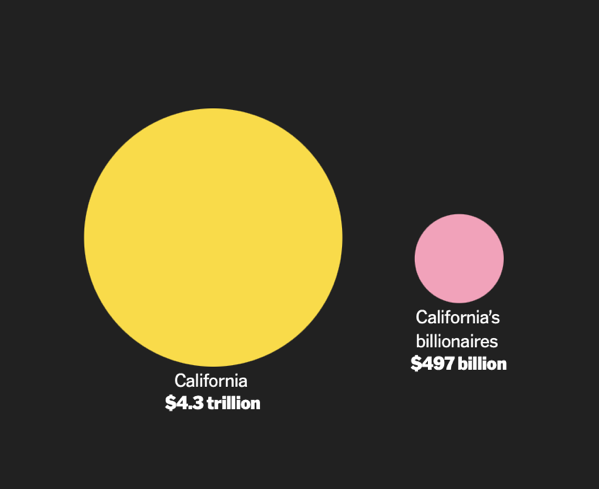
- If any significant number of billionaires leave or restructure their wealth to reduce the tax exposure, that means less taxes for everything else in our general fund… around $1B a year going forward, according to the state Legislative Analyst’s Office.
- Why does almost all this windfall (90%) go to healthcare? What about education or housing?
- While it does “go to healthcare,” Porter points out that it could mostly end up with health insurance companies – “the very entities that helped create our healthcare crisis.”
It is hard to fathom how steering tens of billions of dollars to for-profit health insurance companies somehow solves wealth inequality or addresses our healthcare needs. – Katie Porter
In the end, I think the risks to California’s economy are too great. The only way to do a wealth tax is to make it national, ongoing, and carefully-considered – not just one state, one time, and slap-dash. I hate to say it, but this is the wrong fix to the right problem.
.pps In many ways, this is a classic case of Ballot Measures Suck, but on the other hand, I can’t imagine how we could do this in the Legislature or get a Governor to sign it.
.ppps In case you’re wondering why this isn’t better policy, it’s by the same people (person perhaps) as the noxious Prop 44 below. It’s worth a read to see their M.O.

Prop 41: (a.k.a. Prop 40 Poison Pill #1) Audits of Special Taxes / Spending Limit
NO-NO-NO
Bottom line: Regardless of how you feel about Prop 40, this makes collecting new taxes in California much harder.
These next two measures, 41 and 42, were placed on the ballot by Google’s Sergey Brin (oh what happened to you Sergey? 🤮) as “reasonable sounding things that contain a provision that kills Prop 40”. And he’s put in big money to fund them. It’s a time worn strategy in ballot measure politics & it may well work again here.
Both of them are bad policy and deserve your No vote, however you feel about Prop 40:
- ✅ The Pro-Prop 40 Case: Maybe you believe our wealth disparity problem is more important than arguably really bad policy that may/may not hurt CA’s economy? If so, I get it, though I disagree. Anyway, you want to vote No on Props 41 and 42 so Prop 40 passes.
- ⛔️ The Anti-Prop 40 Case: Maybe you believe our wealth disparity is a huge problem but 40 is really bad policy that will likely hurt CA’s economy? If so, ME TOO! Anyway, you want to vote No on Props 41 and 42 because they’re bad policies that will have bad long term consequences on the state.
The key problem is that whatever you think of Prop 40, these don’t just kill it, they tie California’s hands on tax revenue for good.
Prop 41 is basically designed to kill Prop 40 and reduce California’s ability to effectively collect new taxes.
Prop 41 forces any new taxes created by the state to fit under the “Gann Limit Cap” rather than be allowed to avoid it, which many voter-approved taxes do today. (The Gann Limit Cap means if/when the State collects more than the cap allows, the Gann restriction applies: the additional funds 💵 get split equally across refund checks to the public and schools. None of it goes to what voters passed the tax for.) This new restriction will only affect future stuff – not Prop 40, because if Prop 41 passes with more votes than 40, 40 is just dead. The Gann stuff is really just a smokescreen to cover for knifing 40. 😡 This is terrible.
Prop 42 is basically designed to do two things: kill 40 and never let CA create a new wealth tax.
Prop 42 permanently bans new taxes on personal property, including savings, stocks, retirement accounts and real estate. You know where the rich really keep their wealth? Savings, stocks, retirement accounts and real estate. 😡 This is terrible.
You may hear some say, “Vote for Prop 42 so they can’t tax your 401K!” but that’s just dumb fearmongering because if you don’t have Brin kinda money, Prop 42 isn’t about protecting you. If you do have Brin money and are reading this, I can send you a list of GOOD things CA needs that you should be spending your 💰💰money on.
So any way you slice it, NO on Props 41 and 42. 😡😡😡
.ps I just realized that as a final F@#$K you to the Great State of California, if Prop 40 doesn’t pass but either Props 41 or 42 do, their terrible policy is alive and well, and likely even if 40 passes too (I’m sure there’ll be lawsuits sorting this mess out).
Prop 42: (a.k.a. Prop 40 Poison Pill #2) Prevent Taxing Rich People
NO-NO-NO
Bottom line: Regardless of how you feel about Prop 40, this prevents California from taxing wealth effectively.
See Prop 41 above.
Prop 43: Local Tax Vote Threshold
NO
Bottom line: A horrible prop that prevented a more horrible prop
Just in case you haven’t had enough tax policies smacking your 🧠, here’s another one. The good news is it’s simple: it’s patently terrible. The author, a well-respected and super smart legislator, wrote it for the horrible, terrible, and not good Howard Jarvis Tax people. Wait – howzzat?
It starts to make more sense when you learn that Assemblywoman Buffy Wicks from Oakland put this on the ballot as part of a deal with the Howard Jarvis Taxpayers Association, in exchange for them abandoning a worse version that they had qualified for the ballot through signature-gathering. Wicks is, of course, “adamantly opposed” to the measure. (For a good summary of the loopy politics that got us here, read The Chronicle’s write-up.*)
For longtime Deep Slate readers, you may recall that every few election cycles, I rail about the evil of Prop. 13 and how it decimated California’s tax base, and how our state has struggled ever since. The reason that Prop 13 comes up is usually because the anti-tax crusaders at the Howard Jarvis Taxpayers Association have reared their ugly heads in yet another attempt to have California shoot itself in the head with bad tax policy. (Howard Jarvis and Paul Gann** gave us Prop 13, the greatest self-own in CA history, as far as I understand CA history.)
Prop 43 changes the State Constitution to require a two-thirds vote for local special taxes. Right now those only need a simple majority if regular citizens gather signatures to put them on the ballot, and a two-thirds majority if local officials put them on the ballot. Two-thirds is a MUCH MUCH higher bar for taxes to pass and it means that we’d be lucky to get most good taxes over the finish line, thus shooting ourselves in the head, as the Jarvis folks always seem to want us to do. For example, the critical Prop H and Regional Transit Measure (below) only need a simple majority because citizens put them there. Under Prop 43, measures like these would need two-thirds.
* But by all means ignore their asinine position: “Yes this is stupid, but it doesn’t matter if we make things worse, because our tax system sucks.”
**Those of you following along may recognize that name from the terrible Prop 41 above!
Prop 44: Community Health Clinic Shakedown
NO-NO-NO
Bottom line: Wanna shake down a political opponent? Make a ballot measure!
Before I get into why this makes me SO 🤬, let’s pretend for a moment that this is a ballot measure about health care spending and health clinics for low income folks, as it purports to be.
Prop 44 simply says clinics must spend 90% of their revenue on patient care, capping everything else at 10%, and the Attorney General fines clinics that miss the target.
A quick read of the official ballot arguments show many highly credible organizations pushing back, and the rebuttal itself states:
Prop. 44 will:
- Cut $1.7 billion from health clinics in the first year alone.
- Cause 88% of all clinics in the state to operate at a loss.
- Force thousands of clinics throughout the state to cut back patient services or shut down entirely.
- Eliminate care for millions of Californians.
- Send more patients to hospital emergency rooms—increasing wait times for all families.
So you could stop there and be done. Vote No and move on. But if you wanna uncover what’s really going on:
This is another ballot measure I naively took at face value until I researched and considered. Requiring health clinics for low income folks to spend 90% of their budget on care seemed like an easy yes. 🤷🏽♂️
But I wondered why it needed to be on the ballot? A little reading produced the obvious fact – there’s no need to stipulate this on the ballot, there doesn’t seem to be any evidence that these clinics aren’t doing fine; for the most part they’re delivering quality care and spend their money appropriately on their patients. Why is this happening at all?
At that point, part of me started thinking that this is like those stupid kidney dialysis ballot measures a few cycles ago. (Man, those pissed me off.)
That’s when I discovered the union that put this on the ballot, SEIU-UHW, is the same damn people behind that kidney dialysis stuff!!! I’ve said NO to this union’s ballot STUPIDITY in 2018, 2020, 2022 and here I am doing it again in 2026.
I had practically started writing the “I’M SO TIRED OF ALL THE DUMB FROM THIS UNION” piece when I read my friend Alix Rosenthal’s excellent take on Prop 44 and a deep dive on SEIU-UHW’s tactics. She carefully describes their pattern of putting up ballot measures to pressure people as a “negotiating tactic.” She compares it to a mob boss talking to a health clinic on their turf: “Nice clinic you’ve got here, shame if something happened to it.” (Emphasis mine.)
That second version is much closer to the truth IMHO. I don’t know why Alix pulls her punch, maybe because she’s a lawyer and smarter than I am, but this is racketeering plain and simple. Even the California Primary Care Association (the health clinics association) have brought a lawsuit against SEIU-UHW calling it racketeering and suing the union under anti-mob laws! Reading around about the suit yields this explosive fact from CalMatters:
The association and several clinics allege the union has unlawfully offered to kill Prop. 44 in exchange for more union membership at clinics or for the association to withdraw its opposition to the SEIU-UHW supported billionaire wealth tax. [Prop 40]
There it is in black and white: SEIU-UHW put 44 on the ballot as leverage to get the clinics to drop their opposition to Prop 40, the Billionaire Tax, or to let SEIU-UHW organize their workers. And the Sacramento Bee notices that SEIU-UHW isn’t even bothering to spend money on 44, but the NO folks have had to spend a bunch, because it’s a huge threat to them. Bullets are cheap, but your life isn’t.
There is so much terrible, illegal, and unethical behavior here … I don’t even know what to say 🤬🤬🤬🤬.
Vote OH HELL NO.
.ps SEIU-UHW is the same group who brought us Prop 40, the billionaire tax. So the SEIU-UHW union brought us 40 & 44, and billionaires brought us 38, 41, and 42. All of them are bad policy. Ballot measures do, in fact, suck.
Prop 45: CEQA Changes
NO-NO-NO
Bottom line: Letting the fox write the henhouse rules: NO ❌
Ed. Note: It’s surprising that the best article I’ve read on this is The Chronicle’s, because they’re not always “enviro first”, but they nail this one. (👏🏾👏🏾👏🏾 Chronicle ed board.) It’s laid out compellingly, and I recommend you just read their endorsement editorial instead: Endorsement: CEQA is a mess. Prop 45 is even messier.
(Did I mention I’m tiiiiiiiiired of writing and this is my last ballot measure write-up!?)
What’s CEQA?
Governor Reagan signed the California Environmental Quality Act in 1970. Essentially, before a project is approved, officials study its environmental impacts and the public gets a say.
What does Prop 45 Do?
Prop 45 fast-tracks environmental review for eight kinds of projects it calls “essential”:
- Housing
- Water (except the Delta tunnel)
- Clean energy (except nuclear)
- Healthcare
- Public safety and wildfire
- Broadband
- Education
- Transportation (except high-speed rail)
It sets several hard deadlines for parts of the CEQA review process, puts limits on public input and lawsuits, and protects itself against legislative amendments.
Why I don’t love CEQA, and I’m an Environmentalist?
This should be my favorite thing ever, but CEQA has become cover for anyone to argue against building anything they don’t like at any time. That’s terrible enough, but it’s particularly noxious when it’s used against obvious environmental goods, like better public transit, infill housing (which prevents sprawl), and bike lanes that would take cars off the road (yes, I believe I’ve actually seen all of these).
So the funny thing is, environmentalists have a REALLY complicated relationship with CEQA: in many cases we use it to promote good environmental causes like fighting against logging roads through sensitive habitat, to protect endangered species faced with an airport expansion or a golf course in their habitat, or considering air quality impacts of a new factory. But it’s also used against us a lot of the time. Many of us do want to see CEQA reform. Why, then, are the Sierra Club California, Enviro Voters, Clean Water Action and many other environmental groups against it?
It turns out that even if you want CEQA reform (and I do), this isn’t it.
How did this get here?
This is the fox putting forth a ballot measure on “Henhouse Access Reform”. In this case, the fox is the California Chamber of Commerce, a well-known CEQA opponent, who paid to get signatures to put this on the ballot.
Like any excellently weaponized ballot measure, they poll-tested everything to make it sound more appealing. Particularly galling is that transportation projects like more highways and the sprawl they engender get fast-tracked, but high-speed rail, a big “reduce greenhouse gases” win, doesn’t – because the poll testing came out against it.
How should it be done?
The truth is that CEQA does need to be reformed, but it needs to be done so carefully and thoughtfully, and that has been happening in the legislature (I see you Scott Wiener and Buffy Wicks!) to do things like exempt infill housing and speed up clean energy permitting.
Prop 45 is the wrong way to do it: pick a bunch of things, some probably good, some terrible. Fixing it would require another ballot measure or a 2/3 vote of the state legislature (as per stipulation in the proposition).
VOTE NO.
JUDICIAL:
Supreme Court
Both Yes
Bottom line: Yes
The Chronicle says it all:
California has a thoughtful and thorough system in place for appointing judges. Every four years, voters are given the important yet perplexing job of deciding whether to retain a slate of judges who already serve. None of the justices up for retention in the November election have been cited for disciplinary matters on the Commission on Judicial Performance’s database, nor have our queries into their backgrounds turned up any red flags. We recommend a “yes” vote on all of them.
Court of Appeal, Dist 1-5
All Yes
Bottom line: Yes
See above.
SAN FRANCISCO:
Assessor-Recorder
Joaquin Torres
Bottom line: Running unopposed. ✅
Joaquin Torres is running unopposed, and his office caught the transfer tax loophole that Prop J closes. Nice.
Public Defender
Mano Raju
Bottom line: Running unopposed. ✅
Raju is well regarded and he’s running unopposed. Done.
Board of Supervisors, D2
Stephen Sherrill
Bottom line: Has no serious opposition and is decent. ✅
For details, see what I wrote in June about him or what the SFLCV wrote. Here is a snippet:
Sherrill is a strong supporter of public transit in San Francisco, including the November 2026 Stronger Muni for All (Proposition H) and Connect Bay Area (the Regional Transit Measure or RTM) transit funding measures, pedestrian infrastructure, and other transit-first improvements. We also appreciate his support for the Family Zoning Plan and his co-sponsorship of an Enhanced Infrastructure Financing District to facilitate 1,200 new housing units in development at 3333 and 3700 California Street. We disagree with his opposition to the proposed 25-story apartment complex at the Marina Safeway site and urge him to use his position and skill to navigate complex and controversial projects like this development.
Board of Supervisors, D4
Ugh
Bottom line: Same 💩 Show, Different Election
Since it is the same candidates as the June Primary, I’m gonna say the same thing I said then, verbatim.
Ugh. District 4 is in fact a 💩-show. Here’s a bit from our write-up at the SF League of Conservation Voters:
Although three of the candidates — Alan Wong, Natalie Gee, and Jeremy Greco — showed real alignment with our priorities in some areas, none made a compelling enough case across each of these critical issues (housing, transportation, and Sunset Dunes) to earn our endorsement. Wong supports density and transit-first measures but hasn’t supported maintaining Sunset Dunes as a permanent park. Gee supports many transit-first policies but proposes restrictions to the Family Zoning Plan and also doesn’t support keeping Sunset Dunes permanent. Greco supports Sunset Dunes, but offered unclear reservations about Slow Streets and upzoning.
So: none from me either.
Board of Supervisors, D6
Matt Dorsey
Bottom line: Dorsey, the incumbent, is the only real candidate in the race ✅
Matt Dorsey is the only serious candidate in the race and is expected to win easily. Here’s what we said in the SFLCV endorsement:
Dorsey has been a reliable supporter throughout his tenure on the Board of Supervisors of initiatives aimed at increasing San Francisco’s housing stock and removing barriers for development. He voted to approve the Family Zoning Plan, which reformed zoning rules along major transit corridors to allow for taller, multi-family developments throughout the city….
On transportation priorities, Dorsey has supported a redesign of Folsom Street, which will add a transit-only lane for Muni, new bus boarding islands for the 12-Folsom and 27-Bryant, and protected bike lanes. He also supports making similar improvements on Howard Street. … Finally, he was a co-sponsor of the successful 2024 measure to establish Sunset Dunes, the oceanfront park created by fully pedestrianizing the former Upper Great Highway. Each of these efforts help make it easier and safer for San Franciscans to walk, bike, or use transit instead of driving.
Done. ✅
Board of Supervisors, D8
Gary McCoy
Bottom line: Gary is the right candidate for this and has been for the whole race. ✅
This has been a crazy race, with Manny Yekutiel jumping out to a significant lead in both polling and fundraising. Gary McCoy has been working hard to catch up, but with Manny exiting the race*, it is Gary McCoy’s race now. I’ve worked with Gary several times in the past in his various roles in local government and have always found him to be exactly who he presents in his campaign: hard working, smart, capable, and thoughtful. His body of work for San Francisco alone made him the most qualified candidate for the race when he entered, but also his policy ideas have been the most well considered. Here’s what we wrote at SFLCV:
McCoy espouses the connections SFLCV has argued for since our founding: climate policy and the daily work of running this city are the same work; safe streets get people out of cars; housing near transit shortens the commutes that drive our emissions; conservation-focused planning regarding water, energy, and waste ensures we are thinking of the future impacts of nuanced and complex decisions.
District 8 has had a lot of great Supervisors and I for one have high expectations for Supervisor McCoy. ✅
*As an aside, I’ve worked with Manny several times on Valencia Street issues, and think well of him. I can only hope that he learns and grows from the situation he’s created, and continues to bring the many positives he has delivered to our community here in the Mission. I also hope for the best for those who came forward in this situation and applaud their courage.
Board of Supervisors, D10
Theo Ellington
Bottom line: Ellington is the Best Candidate in a Crowded Field ✅
Theo Ellington is a Bayview native who has done the work for his district for quite some time. He’s been a leader in the environmental justice issues that continue to plague the Bayview and is both smart and experienced. Here is what we said in our SFLCV endorsement:
Ellington’s environmental work in southeast San Francisco is rooted in lived experience. As a Bayview resident, he has been a consistent advocate for accountability at the Hunters Point Shipyard. After concerns emerged about the cleanup process, he organized with neighbors and became a lead plaintiff in federal environmental litigation related to the site. He has also served on the Southeast Community Facility Commission, focusing on public health impacts tied to the Southeast Treatment Plant.
Ellington is the best candidate for the Bayview. ✅
Board of Education (3 seats)
Kim, Tung, Fisher
Bottom line: Kim, Tung, Fisher are the best candidates to help the School Board meet its challenges
BIG CAVEAT: These endorsements are straight from the SFLCV process, and I was not able to attend the meeting where the School Board was discussed. As such, I have even less than my usual admittedly small understanding of the School Board. Thus if you have any better insight or personal experience with candidates, go with yours.
The one candidate I do have some personal experience with is Phil Kim, who impressed me back in June when I was present for our interview with him:
The one candidate in the SFUSD race that seems really focused on the critical details of running the school system (fiscal responsibility, organizational effectiveness, enrollment, facility planning) is Phil Kim.
(As the parent of a school-age youngin’, I feel like it is worth disclosing that my child does not attend an SFUSD school, so I do not have first-hand knowledge of SFUSD as many of you may. I tell you that to inform how you weigh my comments against your own lived experience of the SFUSD system.)
Community College Board (3 seats + 1 Partial Term)
Ball, Lace, Tam, Ferguson
Bottom line: Elijah Ball stood out as the single best candidate in the SFLCV process.
BIG CAVEAT: These endorsements are straight from the SFLCV process, and I was not able to attend the meeting where the Community College Board was discussed. As such, I have even less than my usual small understanding of the Community College candidates. So if you have any better insight or personal experience with candidates, go with yours.
All that being said, Elijah Ball was the singular candidate the SFLCV felt we should endorse. Other than Ball, I went with Monroe Lace and Erwin Tam and also Ruth Ferguson is completing her term (which counts as a separate election). I haven’t had a chance to do much due diligence here, but as both The SF Democratic Party and The Chronicle line up on these races, I expect them to win 🤷🏽♂️. The Chronicle editorial on this race seems worth reading and I’ll try to get to it.
BART Board, D8
SARA BARZ
Bottom line: WOOOT! SARA IS AWESOME.
Sara is a dear friend, but more importantly she’s super smart, passionate about transit, and is ready to roll up her sleeves and get to work.
THE BAD NEWS: I don’t live in her district, and Kimberly won’t let me move. 😭
THE GOOD NEWS: She’s unopposed, so she doesn’t need my vote! 🏆
Prop A: Reasonable Commission Streamlining
YES
Bottom line: Reasonable cleanups of San Francisco’s bureaucracy: too much crap is in the City Charter. ✅
Two years ago, we approved Prop E to create a task force to streamline our city’s boards and commissions. I was all for it! Our City Charter has become bloated and sad (how bloated? See Prop D) and a lot of things in it simply shouldn’t be. Many folks agreed, and it passed.
That task force came back (after a year and after doing a lot of work and getting a lot of input) with numerous recommendations – some easy and straightforward, and some terrible. After MUCH debate of what’s reasonable and what’s not, the Board of Supervisors voted 9-2 to put the uncontroversial parts on the ballot. It’s a difficult line to walk, and I think they mostly got it right (from SFLCV):
The most significant changes Proposition A would make include:
- Requiring the City to convene a Streamlining Task Force at least every 10 years to evaluate whether City boards and commissions should be reformed or eliminated.
- Allowing the Board of Supervisors to modify specified voter-approved initiative ordinances that relate to boards and commissions. (Typically, initiative ordinances can only be amended via another voter-approved initiative.)
- Removing requirements for boards and commissions to prepare annual statements of purpose and annual reports.
- Eliminating some boards and commissions entirely. These include the Sanitation & Streets Commission and the Public Works Commission.
- Moving the legal authority establishing numerous commissions from the Charter to the Municipal Code. This would allow the Board of Supervisors to make future changes to those commissions, including potentially eliminating them entirely, via ordinance rather than via Charter amendments.
- Miscellaneous changes updating Charter language including to modernize it and fix errors.
I like these bits in particular:
- It drops the number of commissions in the Charter from 55 to 38 by moving some to the simpler-to-adjust Municipal Code, and dropping some duplicative or outdated ones.
- It will save us something like $400K a year.
- It will convene a cleanup-the-Charter task force every decade, because hoarding is a government weakness.
So YES.
Prop B: Prep for a Public Bank
YES
Bottom line: A public bank would be amazing for economic justice, decarbonization, and affordable housing. ✅
Ever stumble into a subject and find that there is a growing fandom and geekery around the subject that you were unaware of?
I just learned that public banks are a THING. They even seem to be hip in some crazy Venn diagram of general-do-gooders, climate activists, economic justice activists, housing activists, and just plain old policy wonks*. AIN’T NO PARTY LIKE A PUBLIC BANK PARTY COZ A PUBLIC BANK PARTY DON’T…. Profit? HEY THAT WORKS.
Ok, I may be a little punchy. I’ve been literally writing this guide for a week nonstop (so far!). Seriously. 🫠
So public banks are on the rise in the US, though nobody here has made one except the Bank of North Dakota in 1919… that’s a whole ’nother story – but note that it seems very successful and popular in ND! Basically, since the 2010s, a growing movement has been trying to bring this phenomenon (common in Europe and elsewhere) to the US.
“While tremendously exciting, from a global perspective, San Francisco is a little late to the party. Public banks are a proven and tested model. In 2024, over 1,100 of these institutions worldwide held $91 trillion in assets. Public banks are a safe way to put our public money to work for the public good. […]
It’s been a long road, but they’re starting to gain some tenuous traction in the US, and San Francisco should jump in with both feet. Passing Prop B would be the first real “toe dip”, to prove we should and could make such a jump.
To understand Prop B, I had to go through these phases (and so do you):
1. WTF is a public bank? Do I care?
For various types of projects in cities like ours, such as building affordable housing, project backers take out loans. With these loans, they make big interest payments, and those interest payments are the profits for the bank and investors.
But if the bank was a public one (owned by the City, but not run by the City), the interest payments (a.k.a. profits) would go back to the City, to be used for more loans or lower interest loans than commercial banks charge – so the profits stay in SF. This kind of plan could be a godsend for numerous types of projects. SPUR puts it well:
SPUR recognizes the significant potential of a public bank as a tool to advance San Francisco’s public priorities and expand the city’s capacity to invest in communities. A well-designed public bank could help address gaps in access to capital by financing affordable housing, small businesses, climate resilience, and environmental justice projects that traditional financial institutions may underserve. It could also keep more public resources circulating locally, provide flexible financing, and create revolving loan programs that allow public dollars to support multiple projects over time.
2. So does Prop B create a public bank?
No, this creates the training wheels version: a lending organization called a Municipal Finance Corporation (MFC), which still needs to get funded from a yet-to-be-determined source. Think of Prop B as permission to get the ball rolling. Prop B establishes the creation of the MFC and its rules, then we find the money to make the MFC. If the MFC proves itself to responsibly lend money and otherwise do good, after a few years it can become a bank. From the SF Public Press:
Proposition B — titled Establishing a Municipal Finance Corporation and a Public Bank — would not immediately create a bank, raise taxes or provide money to start one. Instead, the Charter amendment would authorize the city to create a nonprofit lending institution called a municipal finance corporation. Funding would have to be secured separately, potentially through city appropriations, grants, foundations or contributions from banks.
Proposition B would spell out what the institution may or may not do with its money. It would prioritize goals such as affordable housing, economic opportunity and environmental sustainability, while avoiding investments in industries the measure considers harmful, including fossil fuels, tobacco, weapons, prisons and detention centers, predatory lenders and businesses that violate labor laws.
3. This seems like a great idea! Wait, why are SPUR and The Chronicle against it?
SPUR, The Chronicle and Prasad Krishnamurthy (a Berkeley Law professor who specializes in financial regulation) raise several objections:
- We don’t have the funds to start such an MFC, so why are we even voting on it?
- There are better, existing instruments to fund things like affordable housing.
- A public bank just moves the risk of bad investments to us, rather than private institutions.
- Prop B adds a lot of bloat to the City Charter (which, as I’ve agreed time and time again, is a bad idea).
So let’s discuss these.
The easiest is “we don’t have the funds”: Prop B lays out the structure of the initial step, and very purposely does not ask for funding. The idea here is to get voter approval for the structure before tackling the thorny problem of seed capital. A well defined governing proposal already in law (Prop B), will be critical to help secure funding, wherever it ultimately comes from. This means that there is almost no real downside of passing B, because no one is asking for money yet.
The next argument that there are better instruments for funding these kinds of programs is, at best, a partial truth. Sure we have means of funding affordable housing, but we’re not doing a lot of it; if we were, things like Prop C and Prop I probably wouldn’t need to be on this ballot. Sure we might be funding low interest loans for small businesses by disadvantaged populations, but we could be doing that a lot better. And there are many climate related mitigations that require capital, like funding home electrification efforts, or EV charging stations, but we’re not doing that particularly well. Some of these projects may be possible using standard municipal bonds and similar sources, but many more would be possible with a public bank.
That leaves the two strongest arguments – first that Prop B dumps too much bloat in the Charter and secondly that a public bank could easily be a vehicle for bad loans driven by political popularity and whims rather than sound investment strategy. And when such bad loans defaulted, it would be the City, and therefore the public, holding the bag.
The Chronicle rightfully points out the risk of political meddling and shortsightedness destroying a public banking effort – it’s happened in the not too distant past here in California, when the Los Angeles Community Development Bank was created in 1995 with $430M of federal money:
Focused on rebuilding neighborhoods following the 1992 Los Angeles riots, the bank faced heavy criticism from federal and local housing officials for poor management, severe political meddling and rushing into non-compliant deals. The bank aggressively pushed to fund high-risk, ill-conceived projects, had an astronomical loan default rate and was forced to close by 2004.
But the quote above itself explains the response to both of these critiques: the risk of political winds driving bad investment strategy is very real, and that is why the structure, governance, and lending rules that “spell out what the institution may or may not do with its money” need to be enshrined in the Charter, where Boards of Supervisors and Mayors, and yes, us, don’t get to casually tweak them to respond to the current political mood. The LA Bank had none of these protections in place. Putting strong structure in the Charter is an essential guardrail, not a liability.
4. Cautious and optimistic all at the same time
In the end, I think some risk is real, and the public would in fact hold the bag, but there is a time to dream big and try big things. Prop B is a smart, cautious toe dip – exactly the kind of thing you must do before you decide whether to jump. Let’s do it! Vote Yes on B, LET’S GET THIS PUBLIC BANK PARTY STARTED!
.ps It’s worth pointing out that this whole effort has two really big hills to climb even if Prop B passes: a timeline problem, and an even bigger funding problem:
- The state law authorizing a public bank seems to have a shot-clock: the full bank has to be licensed by 2029 and this MFC+Bank plan doesn’t have enough time, so an extension from Sacramento will be required.
- Even with an extension, credible estimates are that the MFC will need about $90 million for the first three years, which seems plausible, but the full bank will need to find somewhere in the range of $300M-$460M, which seems decidedly less so. (Especially given that the controller says we’re already facing a $1B deficit by 2030.)
* Hi Paul! Thanks for dragging me into this 🐰🕳️!
Prop C: Upgrade the Housing Trust Fund for More Affordable Housing
YES
Bottom line: A carefully negotiated budget set-aside 😑 to fund affordable housing construction. ✅
This year’s ballot has two SF measures, Prop C and Prop I, that address affordable housing needs in markedly different ways.
A city study concluded that in order to make housing construction viable in San Francisco, various stipulations need to be relaxed. Chief among these was the code requirement that 15% of all constructed units be affordable.
After much negotiation, the BoS and affordable housing advocates agreed to slash this to 5%, as long as the General Fund would be tapped to expand the funds available for affordable housing – essentially agreeing to a smaller percentage requirement for new affordable housing in exchange for a stable and dedicated pool of money for affordable housing. Voilà Prop C (the general fund tap) was born!
What became Prop I was a competing measure to shore up affordable housing funding by officially redirecting a significant portion of 2020’s real estate transfer tax from the general fund to affordable housing. Its original backers dropped the measure as part of the Prop C negotiations. However, other activists ran with it anyway, and got it on the ballot via signature gathering.
The fact that both take money from the general fund means they are essentially budget set asides, which as I say, suck. But Prop C manages to tip the scales into worth it (probably because it was carefully designed by consensus), whereas Prop I does not:
- Prop C pulls a steady predictable amount from the GF on a planned and predictable schedule: starting at $52M/year and ramping up (starting in 2028) to reach $125M in 2036. Additionally, for bad budget years, these amounts can be trimmed or frozen – creating a set-aside with a safety valve.
- Prop I is a percentage of a volatile amount: it’s based on how much transfer tax the City collects, and requires that half of any transfer tax on large real estate sales (over $10M) be spent for specific things, regardless of changing budget conditions. In lean budget years we’ll still have to fund Prop I’s housing initiatives based on whatever taxes are collected.
- Prop I also locks the transfer-tax rate (requiring another ballot measure to change it – which sucks), precluding any flexibility due to economic conditions.
- Prop I is funded by the transfer tax collected on property sales over $10M, which rises and falls based on how many big buildings sell and for how much. This makes it vary every year. Volatile funding sources aren’t a great way to fund long-running construction projects with complicated financing schemes.
- Additionally, Prop I requires a significant amount of the funds be dedicated to various alternative housing models, chief among them social housing. While social housing may ultimately prove a good thing, enshrining such experimentation in policy that requires a ballot measure to change, sucks.
In the end, I think C will do the most good with the least downsides, while Prop I doesn’t make the cut.
Various other factoids reinforce my thinking:
- If Props C and I both pass, the impact to the general fund will be very difficult, especially since we already have a structural budget deficit.
- Prop J on this ballot is designed to recoup general fund losses from transfer tax exemptions, but half of the funds it recoups will go to Prop I, further stressing the general fund.
To be fair, Prop I does have some good stuff in it:
- Voters (myself included) voted in 2020 to encourage the city to build 10,000 units of social housing, but I don’t know if any has come to pass? Prop I would probably jumpstart such development.
- Prop I cuts the transfer tax on newly built housing, to help such construction pencil out.
.ps My favorite read on this was Joe Eskenazi’s excellent and entertaining piece (and nice Lurie-rhetoric smackdown): Mayor Lurie blasts Prop. I as a ‘slush fund.’ His office would control the money.
And SPUR’s rundown of this year’s housing measures is a nice overview of all the affordable housing measures on the ballot.
Prop D: Less Ballot Measures Please
YES
Bottom line: Would fewer ballot measures be a problem? I think not. Vote YES. ✅
Now we come to the first of Mayor Lurie’s “Clean Up City Hall” trifecta: Props D, E, and F. The Mayor is pitching these very clearly, loudly, and expensively, as his take on making SF government work better, cheaper, and faster. For me, D and E are clearly good ideas; while F is the most dicey, I’m still leaning yes. The fact that I’m for all of them means I can already hear people saying “He’s with the Mayor” 😐. I’m definitely NOT (see below).
I’m for these because I don’t believe the SF government works as well as it should. There is a lot I love about our government (come on imagine how much crazy we DON’T have to deal with here), but there is a LOT of room for improvement. Off the top of my head:
- Spinning circles trying to improve pedestrian safety: 2014’s Vision Zero plan was supposed to get us to 0 traffic deaths by 2024, but we ended on 49, higher than we started.
- Building permitting is BRUTALLY long. Much, much longer than anywhere in California.
- We drown in well-meaning ballot measures. All. The. Damn. Time. For example, the November 2024 SF ballot had 15 City measures; Oakland had 3 and San José had 1.
But beyond my complaints, actual smart people at our very own think tank SPUR (who I generally agree with on a lot of things) posted a blueprint for making things better, zeroing in on San Francisco’s Charter as the key to numerous problems. This was SPUR’s Charter for Change, a plan to tackle our 548-page City Charter (New York’s is 340 pages; Seattle’s is 23!). 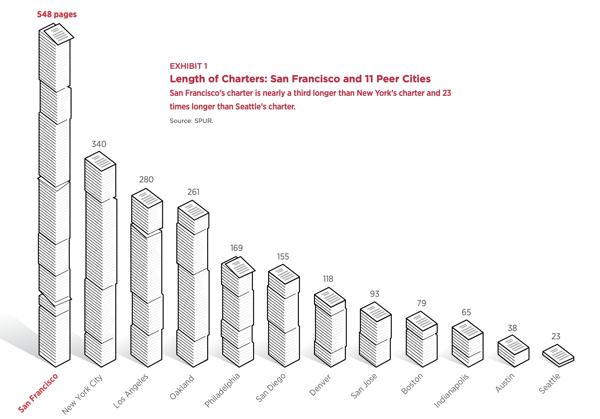
SPUR’s Charter for Change document is largely what we’re voting on in Props D, E, and F. (A great synopsis of the report and how it led us directly here is Mission Local’s “Urbanist think tank SPUR unveils plans to revamp S.F. charter” – I highly recommend it!)
While these won’t fix everything on my list, a lot of what’s in Props D, E, and F really resonates with me:
- D: As I’ve said for years, ballot measures are a bad way to govern, and I think we should have fewer of them. And this is a relatively modest change.
- E: One significant hurdle in getting 💩 done is purchasing and contracting take a long time and struggle under really difficult rules.
- F: Even in this era of Trumpist-executive-power run amok, I tend to believe that the executive branch needs to be able to execute, and often that means hiring/firing.
We’ll discuss them one at a time, starting with D, but first a note about Lurie. San Francisco Politics loves a good “us vs. them” narrative, and I’m probably as guilty as anyone. So for those of you who’ve read this far and think I’m “them” (where “them” means “Team Lurie”), I’m not. I’ve never been big on Mayor Lurie; from what I’ve seen he’s doing some good stuff (the Family Zoning Plan – his, building on Breed’s) and some bad stuff (really bad on police oversight, bad on Market Street, bad on the Marina Safeway housing development, and against Sunset Dunes. And yeah, I took his knifing Sunday Streets personally.) Perhaps his leveraging of the ultra-rich into SF politics is the most troubling aspect of his administration (and yet, here I am, endorsing the three measures they’re spending the most on. 😐)
Ok, back to this ballot measure…
Prop D is a fairly straightforward measure designed to reduce how many ballot props I have to write about. OMG shoot me! we have to consider thoughtfully and vote on.
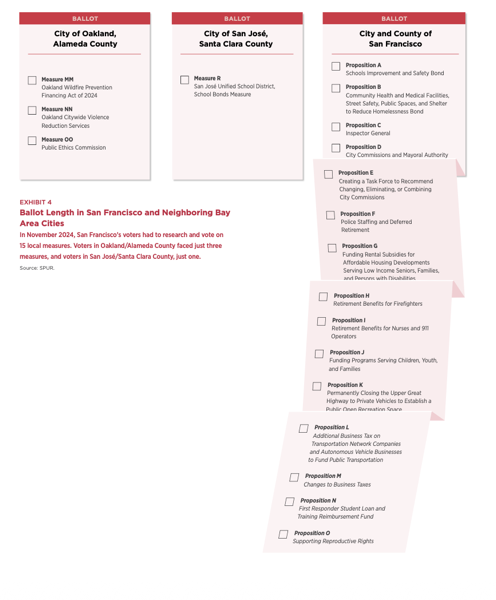
What this does is well explained by SPUR:
Currently, the city charter allows measures to be placed on the ballot through
- the legislative process, which requires a six-vote majority of the Board of Supervisors;
- direct placement of the measure by four board supervisors or the mayor without a legislative process; or
- a voter signature initiative.
Prop. D would eliminate the second option and alter the third by increasing signature requirements for voter initiatives from 2% to 8% of registered voters.
The measure would allow proponents of a voter signature initiative to withdraw the initiative from the ballot before an election, which is not permitted today.
Given how many ballot measures are on this ballot, I think you can understand why I’m ALL FOR THIS! 🫠 But in all honesty, this measure is pretty mild and will only keep a few measures off the ballot (from SFLCV):
From March 2020 through June 2026, 69 measures appeared on the San Francisco ballot by various means. Had Prop D been in effect, the 12 measures placed on the ballot by the mayor or a minority of the Board of Supervisors would have been excluded. Eight others would have faced greater signature requirements and may or may not have appeared on the ballot.
So that means instead of 69 SF measures in 6 years, we’d have had something like 50.
There is a tension between representative democracy (“we elect people to do this!”) and direct democracy (“I want to have a say in things!”). Both approaches have upsides and downsides, but for the most part, I think ballot measures suck. The rough math above suggests about 8-9 ballot measures a year (not counting CA measures) which leaves plenty of room even if you’re a bigger fan of direct democracy than I am.
I think the two most important bits are:
- This isn’t that big a change for signature-gathering efforts, and we’ll be closer to most California cities’ requirements.
- The biggest change here is actually about how the mayor and supes put stuff on the ballot (not signature gathering): instead of just requiring four supes or the mayor by themselves to put stuff on the ballot, it will now require a majority of the board.
I think SFLCV’s conclusion wraps it up nicely:
Both critics and supporters overstate the impact of Prop D. It may be more difficult for certain citizen-led initiatives to reach the signature threshold, but it is still reasonable and keeps charter and recall signature thresholds unchanged.
San Francisco’s current threshold of only 2% of registered voters for non-Charter measures is significantly lower than what other major cities in California require. Oakland and many other cities require signatures from 10% of registered voters.
Prop D’s threshold of 8% would still be lower than most major California cities. San Francisco voters may see some relief on their long and complicated ballots, but changes to the signature-gathering requirements will affect only a fraction of the measures.
For full details, read the SFLCV post here, or SPUR here.
So Vote YES on D. Next up: Prop E, which I think is also (mostly) pretty easy.
Prop E: City Admin Streamlining
YES
Bottom line: Streamline City purchasing so projects get done faster and cheaper. ✅
The second of Lurie’s “Clean Up City Hall” trifecta is perhaps the easiest one. Here’s the short and sweet from SFLCV:
San Francisco’s current slow and expensive contracting procedures can be a major obstacle to accomplishing the City’s environmental priorities, such as projects to improve Muni service, provide affordable housing, enhance public parks, or safeguard the environment. They also undermine the public’s confidence in the City’s ability to effectively address the many challenges that it faces.
Proposition E would empower the City Administrator to simplify contracting procedures and to drive down the cost of goods and services that the City purchases.
According to The Chronicle (drawing on SPUR’s research):
San Francisco’s contracting system has become overly complex, politicized and inefficient. Our municipal codes include the words “contract” and “procurement” more than 8,700 times. Seemingly straightforward tasks like buying software or hiring a contractor can require months of negotiations, approvals, waivers and trips between departments — far more complex than the way it works in the private sector. According to the City Administrator’s Office, the length of time to process a single contract can range from 8½ months to more than 1½ years. And fulfilling a single procurement process costs roughly $25,000 — even if the contract itself is only worth $25,000.
- Consolidates the City’s purchasing rules with the City Administrator, now including various departments that were special flowers 🌼 with their own rules, like Muni, the Airport and the PUC. Note that the Mayor or Board of Supervisors can still reject the rules created by the Admin.
- Gives the Administrator more say over technology and large multi-department projects.
- Raises the “needs Board approval” contract size from $10 million to $25 million (which is commensurate with inflation – the $10 million mark was set in the 90s).
- Extends the City Administrator’s term from five to 10 years, but they can be removed by the Mayor and a majority of the Board of Supervisors.
That last one is what gives me pause: it’s a lot of power concentrated in one place. While it has its risks, the argument is that it’s better for long term capital planning (which has similarly long timelines) and some insulation from politics. Ok, I guess, since they can be removed if need be.
The Chronicle likes Prop E a lot, saying “San Francisco has little to lose and much to gain by professionalizing the way it does business,” while still noting a few reasoned downsides, so worth a read if you’re interested.
If you want the cranky “anything touched by Mayor Lurie must be intrinsically evil,” read the League of Pissed Off Voters for the closest thing to a reasoned “No” I’ve seen. But at some point, if you really want the City to work better, you have to, you know, make changes.
Vote YES on E.
That leaves us with the diciest one: Prop F.
Prop F: Executive Branch Management
Yes
Bottom line: Make “Who’s in charge?!” an answerable question in SF.
This is the final and most controversial piece of the Lurie trifecta. Of the three, this is the one I’m least confident on as well.
But at the end of the day, I tend to believe that one of our City government’s problems is often that “Who’s in charge?!” isn’t an answerable question.
While people generally think that the Mayor is responsible for most City departments, the answer to “who’s in charge?!” is more often than not “a commission.”
San Francisco has many many commissions and most function as “boards of directors” for City departments. These are appointed citizens who set policy, approve budgets, and hire and fire department heads (that’s significant). So the Mayor does not control most departments: the Mayor directly hires and fires only about 6% of department heads.
In addition to “board of directors” type commissions, there are other types, such as the quasi-judicial Police Commission, Planning Commission and the Board of Appeals – which decide specific cases such as police impropriety, planning disputes, etc. Another important type are independent watchdog commissions like Ethics and Elections.
The commissioners are usually appointed by some formula where X% of the commission is appointed by the Mayor, and Y% are appointed by the Board of Supervisors. Then there are various rules as to how they can be removed if need be, often written into the City’s Charter.
So given all that background, what is Prop F and what does it do?
One nice thing about F is that it’s a Charter amendment that takes things out of the Charter! So it gets a ⭐️ Gold Star! Right now the Charter defines all kinds of stuff about how the executive branch works and governmental commissions work. This means changing any of it takes… you guessed it… another BALLOT MEASURE! 🥳 (No, really, they suck. 😞)
Prop F changes most of this “stuck in the Charter” madness (if it passes):
- The Mayor will hire and fire most department heads.
- The Mayor can appoint deputy mayors and delegate the ability to manage departments (Currently the Mayor has to handle over 50 direct reports! 🤯).
- The Mayor can reorganize departments, though the Board of Supervisors can veto changes within 60 days.
- Commissions, which generally oversee departments, lose the power to hire and fire department heads.
- Most commissioners will be removable by whoever appointed them (the Board of Supervisors or the Mayor), though watchdog-type bodies, such as the Ethics and Elections Commissions, are exempt.
In terms of City departments and general executive branch structure, I think this gives us the accountability we need for what does and doesn’t work in our City. When a City department is not functioning well, the buck stops with the Mayor – it doesn’t stop with X% of the commission appointees the mayor picked or the Y% of the commission appointees the Board of Supervisors picked.
Perhaps the biggest poster child for this dysfunction is in permitting. San Francisco has five different departments that review a housing permit, and no one is responsible for it all the way through the process. That’s a significant reason why we have the longest housing approval timelines in California: about 523 days for planning approval plus 605 more for the building permit, roughly THREE YEARS. Mayor Lurie wants to merge Planning, Building Inspection, and the Permit Center into one department – as other cities do – and Prop F will allow him to complete the job by consolidating these charter-defined departments.
Permitting delays hurt remodeling and construction in general, but they’re devastating for affordable housing production. In construction, delay is cost: every month waiting means more loan interest, more inflation on materials, etc., before a single nail is hammered. But since affordable projects generally have fixed budgets (built on complex financing with stipulations), they can’t absorb these costs, so deals shrink (less housing gets built!) or fall apart as costs balloon due to delays.
That’s so compelling that I support Prop F.
But there is a bit of shadiness here when it comes to the Police Commission. ☹️
Unlike other “independent watchdog commissions”, such as Ethics, which are exempted from the “whoever appointed them can remove them” rule mentioned above, the Police Commission is very purposely NOT exempted. The reason the watchdog commissions are generally exempted is so that they can be independent: if they make a ruling unpopular with whoever appointed them, they won’t be sacked for it. Why does Lurie want to be able to have a “somewhat less independent watchdog” when it comes to the police? It is unclear, but to make matters worse, he’s been telling voters the opposite in campaign flyers.
That’s kinda gross…but at the end of the day, “If you want the mayor to be held responsible, you have to give them authority to make decisions.” — Ed Harrington, former City Controller (Mission Local)
Yes on F.
.ps It feels kind of hard to argue for strong executive authority under the shadow of Trump’s presidency, the most unconstrained, illegal, corrupt and amoral executive branch in our nation’s history, but I still think it is true. The Evil Cheeto is doing what he said he would do, so the accountability for “corrupt” and “amoral” flows directly to the American people. We elected him. The part that is a failing of our government is the “unconstrained” and “illegal” – the blame for that falls directly on the other two branches for not doing their jobs: the legislative branch is the primary constraint on the executive (and the judicial on both) and the judicial branch is the legal check on the executive. So at the federal level the problem isn’t with the legal authority the President is exercising as much as it is that the checks and balances our system is predicated upon have failed.
I doubt very seriously such a storm of failures could happen in San Francisco… but I would have said the same for our country.
Prop G: KILL SUNSET DUNES PARK
NO-NO-NO
Bottom line: Putting a dying highway on the ballot repeatedly won’t stop climate change and should NOT stop an excellent new park!
Dear 60% of the Westside –
Look, I know breakups can be hard 💔, but it’s been what? Six going on seven years? It’s TIME to move on.
You can’t just keep trying to get back together with the Great Highway. You know that, right? No matter how many votes you make us do, you’re just prolonging the heartbreak.
And I know you were upset about the “weekends park, weekdays road” compromise after the 2020 pandemic, so you put Prop I on the ballot in 2022, to make it all-road-all-the-time. But you lost. I know that hurt.
And then two years ago, when the 2024 Prop K Sunset Dunes vote happened and you got… well… dumped (55-45 by the whole City!), you really should have just moved on. You’d have been so much happier.
But you couldn’t, could you? Then lashing out at Joel Engardio (who wrote Prop K) – did the recall really help the heartbreak? It doesn’t look like it. I mean, look at you – you’re still in denial.
Your so-called “friends” keep saying, “It’ll be OK if you get back together,” but I got to tell you: Connie Chan, Chyanne Chen and Alan Wong aren’t really your friends. They’re just saying what you want to hear, because they think you’ll like them more for it.
So you’re back again, singing the same, sad song “The traffic in the neighborhoods – it’s less safe” (No, it isn’t), or “I can’t drive my old route to Daly City” (that route was closing anyway) – and so now we ALL have to vote again.
Listen to me, even if you win this time – I’ll tell it to you straight: the Great Highway WASN’T GOOD FOR YOU! It was closed like 65 days a year coz of blowing sand. And it’ll cost at LEAST $10M just to get back together and then about half a million every year for sand removal. What kind of a relationship is that?
The sad fact is: The Great Highway doesn’t love you like that anymore. Things change. Roads change. People change. Climate changes.
The Great Highway is going to leave you someday soon, no matter what – whether it’s coastal erosion or sand, or just the dramatic expense of holding back the sea in this modern era. You will get dumped, no matter what happens in November.
Why don’t you just try being friends with the beautiful Sunset Dunes Park instead? Go on, make a change for the better and get on with your life!
Vote NO on G! You can do it!
You’ll be happy you did! I promise. Come on – isn’t that little skateboarding plover CUTE!
– Your friend, 55% of All of San Francisco
.ps And no more “we can just be friends with benefits” talk. Your so-called compromise (“cars on weekdays/park on weekends”) is just sad. As a great poet once put it:
And I said, “Oh, honey, baby, that’s a dead end
You know and I know that we wouldn’t be satisfied, no.”


[Ed. Note: That is my favorite write-up in this post. I hope you enjoy it as much as I do]
Prop H: STRONGER MUNI FOR ALL
YES-YES-YES
Bottom line: Save Muni from catastrophic service cuts.
Of the many things I LOVE LOVE LOVE about life in the Bay Area, one of the biggest is our transit system (yes, warts and all – hear me out). The first, big smile I get when flying home from somewhere is sitting down on BART and letting the travel-stress melt away. It feels like home.
And, yes, absolutely, there are SO many ways I want to improve BART, Muni and Caltrain. Without them the Bay Area would not be the Bay Area – even for folks who never take transit. (If you’re a car-first person, ask yourself what congestion would be like if all those folks on transit were on the road driving!?)
That’s what we’re facing. Our regional transit systems are in an existential funding crisis.
Why?
- Several systems are designed for 5-days-a-week commutes, which aren’t as prevalent post-pandemic. While the systems still cost the same to operate, fewer people are riding, which means less money is coming in from fares.
- For some agencies like BART and Caltrain, this compounds a second, structural weakness: those systems are over-reliant on funding from fares. This leaves their funding vulnerable to short-term swings (like COVID!), undermining the consistency that builds better systems (and grows ridership).
- And finally, POST-COVID costs for most things have grown significantly due to inflation, and this has led to significantly higher labor and maintenance costs for our transit systems.
All of this is coming to a head now: stop-gap federal funding (thanks Biden!) and from CA (thanks Scott!) has protected us from these realities, but that funding is ending soon, and Bay Area transit will fall off a “fiscal cliff” without new revenue.
If this catastrophe comes to pass:
- BART may be forced to shut down entirely. Even if it doesn’t, service will be cut to only about a third of current service. Fares will rise 50%. 15 stations will close, and much of their staff will be laid off.
- Muni will eliminate up to 20 bus routes, and remaining routes may face doubled wait times. Regular service will end at 9pm.
- Caltrain will cut service to the bone: one train an hour (rather than every 15 minutes on weekdays) and weekend service will be eliminated entirely. They will close more than a third of all stations. (Imagine that for a minute…especially anyone who commutes to the South Bay. All those train folks will be in cars.)
It might not stop there, because of network effects: like any network, our transit system is greater than the sum of its parts. As any part of a network gets better, the whole system gets much more useful for everyone! Hooray 🥳. But the reverse is also true 😢: as each individual route or operator degrades, more and more people will be forced to drive, and more driving will clog our streets more, slowing our transit services more, leading to more driving, and all the systems begin a death spiral.
The solution is obvious. Our transit systems need dedicated funding sources beyond the farebox. The only question then becomes how to do it. These two measures are two different types of taxes. One is a small sales tax increase, and the other is property tax, and both attempt to mitigate impact on low income people, who disproportionately rely on transit:
- The Regional Transit Measure will raise ~$1 billion/year over the next 14 years via a sales tax of 1% in San Francisco (and 0.5% in the four other counties: Alameda, Contra Costa, San Mateo and Santa Clara). This funding is dedicated to transit operations, not one-time projects. And yes, its kinda sucky that this is a sales tax, as they are always regressive (in that poorer individuals feel the bite disproportionately); in this case, it’s actually the least harmful option because the alternatives, like raising fares and cutting service, will affect those poorer communities much more than richer ones. SPUR’s RTM piece covers this in good detail:
As a flat sales tax, Prop. RTM is regressive, meaning it takes a larger percentage of income from low-income households. However, failing to implement this measure would trigger devastating service cuts that will land hardest on those with the fewest resources, particularly people with disabilities, older adults, youth, and people with low incomes for whom transit is not optional.
- Proposition H, also known as “Stronger Muni for All,” will create a 15-year parcel tax (meaning it is assessed on owned land) which will raise ~$180M/year specifically for Muni. The proposed tax is both fair and tiered with almost all single-family residences paying a flat $129 annually, and with larger homes subject to progressively higher rates. The largest commercial properties would pay up to $400,000 annually, ensuring the biggest properties contribute the most. These tax increases for homeowners are very small compared to the dramatic losses in property value if these measures fail – as much as $14,100 for a median San Francisco home, according to City estimates.
San Francisco needs both measures: Muni’s deficit is around $300 million, and the RTM will provide about half, with Prop H providing the other half. Both measures come with strong fiscal oversight provisions.
The biggest concern I can see is that it kinda sucks that the Regional Tax is a sales tax.
For me this is a no-brainer: I hop on BART to go play board games with friends in Oakland. I take Caltrain to watch Bay F.C. soccer games with my wife and daughter, and when she isn’t well enough to bike, my wife picks kiddo up from school on Muni.
If you vote for NOTHING else, please, please, please be sure to VOTE YES ON BOTH RTM and PROP H.

Prop I: Lock Up Transfer Taxes for Affordable Housing
No
Bottom line: Sigh. A problem worth fixing – but not like this.
In addition to the state measures about affordable housing, Prop 1 and Prop 37, there are two SF Propositions addressing affordable housing, Prop C and Prop I. Both have similarly laudable goals (build affordable housing, demmit!), but this one isn’t great: no flexibility for bad budget years, volatile funding source, and overemphasis on social housing. See my write up of Prop C above.

Prop J: Close Transfer Tax Loophole on Foreclosures
Yes
Bottom line: A homeowner’s tax break is being abused by corporate landowners, costing the City hundreds of millions. Close it.
I don’t pretend to be an expert on this, but from reading these two pieces, I think I get it.
- SF Examiner’s writeup is excellent and thorough: Spike in investor tax exemptions for large property sales drives Prop. J.
- SPUR’s Endorsement is as cogent and straightforward as this kind of tax detail can probably be: Removal of Foreclosure Exemption for Real Property Transfer Tax.
Back in 1984, the City created a “transfer tax exemption for foreclosures”. It was designed to help people whose home had been foreclosed upon from also getting slapped with a big transfer tax for selling their home back to the bank. It made sense and made good policy, not uncommon amongst cities. This was all good and well, but recently SF’s Assessor-Recorder Joaquin Torres noticed that this sleepy little exemption, which had normally kept about $3 million per year out of the City’s budget due to homeowner claims, was now keeping $150 million per year out of the budget, from larger institutional foreclosure situations. So roughly a 5000% change (!!!)
From the Examiner:
An analysis of data performed by the San Francisco Assessor-Recorder’s Office this year revealed a startling uptick in the amount of city transfer-tax exemptions being claimed by buyers of large income-producing and investment-oriented properties via foreclosure-related transactions — to the tune of hundreds of millions of dollars.
There wasn’t anything necessarily illegal about the practice, but the $450 million of foreclosure-tax exemptions claimed over the past three fiscal years dwarfed the $50 million in exemption claims The City had received in the previous 15 years combined.
And thus this ballot measure was born. (Since this is a tax, voters have to approve, but since it goes to the general fund, it just needs 50%+1 to pass.)
The ballot measure keeps people from buying large buildings under foreclosure from using this exemption while continuing to protect the small homeowners it was designed to help.
This one really is straightforward. The Supes put it on the ballot 10-0, so no one thought it was a bad idea; the only folks opposing it are Quentin Kopp’s SF Taxpayer’s Association, which is like a gold star ⭐️ for good policy 😃. Vote Yes. Read the articles if you want more details.
Prop RTM: SAVE BAY AREA TRANSIT
YES-YES-YES
Bottom line: Save Muni, BART, Caltrain & AC Transit from catastrophic service cuts.
This and Prop. H – Stronger Muni for All, are part and parcel of the same crisis and the same write up 🙂. Read Prop H above for details!
So there you have it! WHEW!
You got to the end! AMAZE AMAZE AMAZE
.ps Don’t forget to #votingstickerselfie AFTER YOU VOTE! (Take a pic with your voting sticker on your nose & hashtag it as #votingstickerselfie everywhere you can!)
.pps If you want me to email you this (no spam!) every SF election cycle, send me an email and I’ll add you to the distribution list.
.ppps BIG THANKS to all of you who asked for my recommendations over the years. I’m truly honored by your interest! And HUGE thanks to Kimberly, my lovely wife, for proofreading this and also for being so supportive of all my meetings and involvements!
.pppps New here, or wondering how I come up with these? Read About the ’Deep Slate – how I think, my sources, where to vote, and older ‘Deep Slates.
A few days after the election, come back and check the RESULTS by clicking here.
THIS CYCLE’S GUIDES:
- SF Voter Guide
- CA Voter Guide
- SFLCV
- SPUR
- SF Chronicle
- SFBC
- Livable City
- Sierra Club
- CLCV
- League of Pissed Off Voters
- Ballotpedia SF
- Ballotpedia CA
- Alix Rosenthal
- SF Bay Guardian
- SF Public Press
- Mission Local
- Streets For All
GO VOTE!
Thx
‘deep
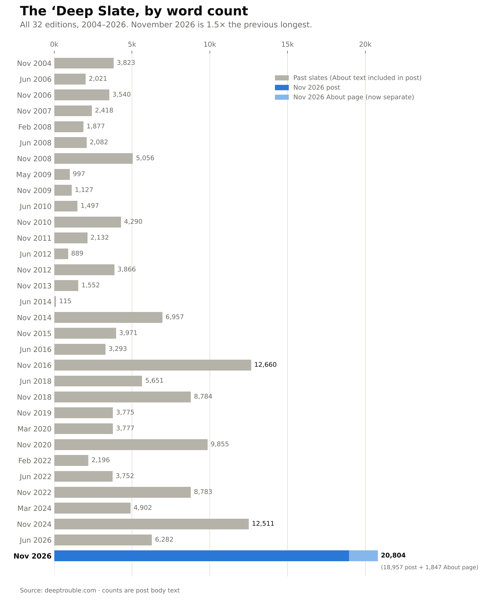 This was a beast of a post! See my comments below for some thoughts…
It’s been a couple of days since I was able to finally “finish” my slate. I’ve had some much-needed distance to re-inflate my brain 🧠 and am willing to type again! 😛
This ‘Deep Slate has been the most intense and longest writing project I’ve attempted in many decades.
Wow.
I blame AI. Mostly in a good way.
To be absolutely clear, I used AI in 3 significant ways (I’m not counting “make it pretty” or “draw this chart”):
1. To do research (asking questions about the details of things, fact-checking me, find articles explaining things)*
2. Proofreading
3. Discussing essay structure options
But it’s #1 that supercharged this ‘DeepSlate, making it the best I think I’ve ever written in terms of accuracy and detail and the longest and hardest to write, because I learned so much and had so much to think about and synthesize. (See the chart above the comments!)
I don’t quite know what to make of it. I *love* how much I learned (reading so many excellent sources) and having help figuring out difficult bits. I really don’t like that it took two weeks of solid writing – I don’t think i can do that every time? The biggest question is whether people like you wil like it? Or is it all too much somehow? (Pls Pls let me know!)
The whole thing was just fascinating.
I don’t think I’ve ever been through something like that. Maybe a thesis I wrote my senior year in college? I’m exhausted. I’m super glad that’s done and even more proud of how it turned out. 👍🏽😃
* The next comment is an example of what I mean. I had read an argument against Prop 41 somewhere that said “it ties the state’s hands” when it came to future taxes. I didn’t get it. You’ll see my prompt’s and Claude’s answers:…
——–
I really don’t understand 41 & how it ties the state’s hands? the audits aren’t the problem – so it must be the gann Limit?
——–
Yes, the Gann Limit is the real mechanism. The audits are mostly cover.
**What the Gann Limit is:** a 1979 voter-approved cap on state spending. It’s pegged to 1978–79 spending and adjusted each year for population and income growth. If revenue goes over the cap two years in a row, the extra money doesn’t get spent on programs. Half goes back to taxpayers as refunds and half goes to schools. ([CA Budget & Policy Center](https://calbudgetcenter.org/resources/what-would-proposition-41-mean-for-california/))
**How Prop 41 uses it:** Prop 40 deliberately writes its billionaire-tax revenue *outside* the Gann Limit, so the money can actually be spent on health care and the rest. Prop 41 says the state can’t collect any tax passed since Jan 1, 2026 that’s excluded from the limit. That’s aimed squarely at Prop 40.
– If both pass and 41 gets more votes, the billionaire tax could be invalidated. (Courts would likely end up sorting it out.)
– If 40 gets more votes, the tax could still be collected, though the audits might apply to the programs it funds.
**Why it “ties the State’s hands”:** going forward, any new tax would have to count under the cap. The state has bumped against the cap in recent years. So if a new tax pushes revenue over the line, the money gets refunded instead of spent, which makes raising money for a new program pointless. Right now it only hits Prop 40, but the Budget Center notes it “could potentially be applied to other tax policy proposals in the future.”
The simple version for your readers: Prop 41 makes sure any new tax money can’t be spent if the State is already near its spending cap. That kills Prop 40 and makes future tax measures harder too.
——–
So it effectively limits any new tax measure the state passes by forcing the state to refund any taxes it collects over a certain amount?
——–
Basically yes, with two refinements:
1. **It only bites when the State is over the cap.** If total revenue is under the Gann Limit, new tax money gets spent normally. The limit only matters once revenue goes over the line, and California has been close to it in recent years.
2. **The excess isn’t all refunded.** Half goes back to taxpayers and half goes to schools. Either way, it can’t fund whatever the new tax was *for*.
What Prop 41 really does is take away the escape hatch. Today a new tax can be written to sit outside the cap, the way Prop 40 is. Under 41 it can’t, so every new tax would count toward the cap.
A one-liner for your readers: “Prop 41 says any new tax has to count against the State’s old spending cap, so once we hit the cap, the new money gets refunded instead of spent on what voters passed it for.”
——–
how do I easily describe the Gann Limit
——–
A few versions, from shortest to longest:
– **One line:** “The Gann Limit is a 1979 cap on how much the State can spend. It only grows with population and incomes.”
– **With the consequence:** “The Gann Limit is a 1979 voter-approved cap on state spending. When the State collects more than the cap allows, it can’t spend the extra; it has to give it back as refunds and school money.”
– **Plain-English analogy:** “Think of it as a spending allowance set in 1979, adjusted each year for population and income growth. Go over the allowance, and the extra money gets handed back instead of spent.”
If you want a link, the [CA Budget & Policy Center’s Prop 41 explainer](https://calbudgetcenter.org/resources/what-would-proposition-41-mean-for-california/) covers it briefly.
——–
how do taxes generally avoid the gann limit today?
——–
There are three main ways around it today:
1. **Voters exempt it directly.** The most common route is for a ballot measure to say its revenue doesn’t count toward the limit. Voters set the cap, so voters can carve out exceptions. Past examples include Prop 10 (First 5 tobacco tax, 1998), Prop 63 (the millionaire’s tax for mental health, 2004) and Prop 56 (tobacco tax, 2016). Prop 40 does the same thing, and that’s the move Prop 41 would ban for new state taxes.
2. **Some spending categories are excluded by design.** Payments on voter-approved bonds, spending required by federal law or courts, certain infrastructure spending, and emergency spending don’t count against the cap.
3. **It isn’t a “tax.”** The limit only applies to tax revenue, so fees and charges tied to a service mostly fall outside it.
Local governments have their own version of the limit. They can ask voters to raise it for up to four years at a time, which is called a “Gann override” and is fairly routine.
So “voters wrote an exemption into the measure” is the main way a new state tax avoids the cap today. The program examples above come from my general knowledge and aren’t checked against a source, so verify any one before you cite it.
Thank you so much for your hard work on this analysis of the items!